
Cat BMI Calculator
Body Condition Score & Ideal Weight
Find out if your cat is a healthy weight using the vet-standard Body Condition Score — the method that’s far more accurate than a simple BMI for cats. Takes 2 minutes.
Is My Cat Overweight? Body Condition Score Calculator
Check 3 physical signs on your cat, enter their weight, and get a BCS score, ideal weight, and a safe plan to reach it.
The 9-point Body Condition Score system is the veterinary standard for assessing feline body fat, endorsed by the WSAVA and used by vets worldwide. Each point represents approximately 10–15% change in body fat from ideal.
Ideal weight is back-calculated using the Cats.com/APOP formula: at BCS 5/9 a cat is at ideal weight. For each BCS point above 5, the cat carries approximately 10–15% excess body fat. Ideal weight = current weight × (5 / BCS), clamped to breed range. Safe loss rate: 0.5–1% of body weight per week. Source: Cats.com; APOP 2023.
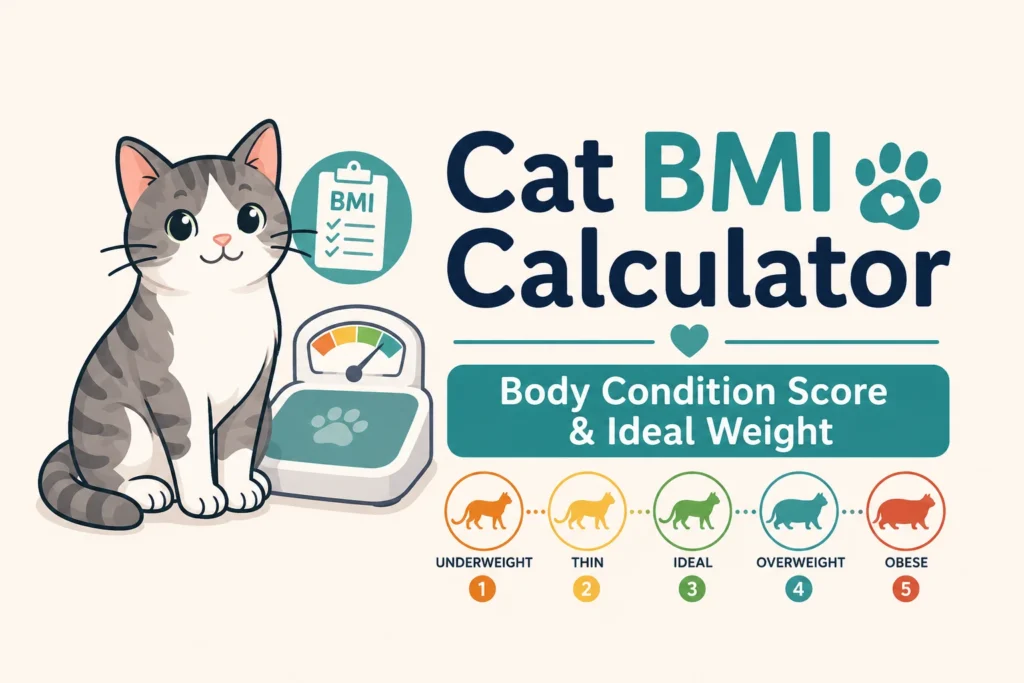
Cat Body Condition Score Chart — Full 9-Point Reference
The complete BCS reference table vets use, with body fat percentages, what to look for at each score, and healthy weight ranges by breed. Use this alongside the calculator above.
9-Point Body Condition Score — Complete Reference
WSAVA Standard| BCS | Name | Est. body fat | What you see (from above) | What you feel (ribs) | Belly from side |
|---|---|---|---|---|---|
| 1 | Emaciated | <5% | Extreme hourglass, ribs visible | No fat, bones feel sharp | Severely tucked, spine prominent |
| 2 | Very thin | ~10% | Ribs visible, very narrow waist | Ribs easily felt, no fat layer | Significant tuck, bony hips |
| 3 | Thin | ~15% | Clear waist, ribs visible on short-haired | Ribs easy to feel, minimal fat | Pronounced abdominal tuck |
| 4 | Lean ideal | ~20% | Clear waist, well-proportioned | Ribs palpable, slight fat | Good abdominal tuck |
| 5 | Ideal ★ | ~25% | Waist visible, no excessive fat | Ribs felt under thin fat layer | Slight tuck, balanced abdomen |
| 6 | Overweight | ~30% | Waist barely visible | Ribs palpable under moderate fat | Minimal tuck |
| 7 | Heavy | ~35% | No waist visible, rounded | Ribs difficult to feel | No tuck, distended abdomen |
| 8 | Obese | ~40% | Wide, oval shape, no definition | Ribs cannot be felt under fat | Sagging, pendulous belly |
| 9 | Morbidly obese | >45% | Massive, no structure visible | Ribs impossible to feel | Grossly distended, waddling |
Ideal Weight by Cat Breed — Healthy Weight Ranges
| Breed | Female | Male |
|---|---|---|
| Domestic Shorthair | 3.6–5 kg | 4–6 kg |
| Domestic Longhair | 3.6–5 kg | 4–6 kg |
| Siamese | 2.7–4 kg | 3.5–5 kg |
| Persian | 3.2–4.5 kg | 4–6 kg |
| British Shorthair | 4–5.5 kg | 5–7 kg |
| Ragdoll | 4.5–6.8 kg | 6–9 kg |
| Maine Coon | 4.5–6.8 kg | 6–11 kg |
| Bengal | 3.6–5 kg | 4.5–6.8 kg |
| Norwegian Forest | 4–6 kg | 5–8 kg |
| Devon / Cornish Rex | 2.3–3.6 kg | 3–4.5 kg |
| Sphynx | 3.2–4 kg | 4–5.5 kg |
| Abyssinian | 2.7–3.6 kg | 3.2–4.5 kg |
Why BMI doesn’t work well for cats
The primordial pouch — not obesity
How to Tell If Your Cat Is Overweight
Over 60% of domestic cats in the US and UK are overweight or obese — yet most owners don’t realise their cat has a weight problem. Cats carry excess weight differently from humans, and it’s easy to miss until BCS is significantly elevated.
A study in the Journal of Veterinary Internal Medicine found that 58% of cat owners incorrectly assessed their cat’s body condition — most underestimated how overweight their cat was. This “fat cat bias” means our eyes normalise what we see every day. The physical rib check is far more reliable than visual appearance alone.
The most reliable home check is the rib test. Place both hands on your cat’s ribcage with fingers along the side of the chest and thumbs meeting at the spine. If you can feel individual ribs easily with light pressure — like the knuckles on the back of your hand — your cat is at a healthy weight. If you need to press firmly before feeling ribs, there is a significant fat layer. If you can’t feel ribs at all, your cat is obese.
Then look at your cat from directly above. A healthy-weight cat has a visible narrowing of the body behind the ribcage — a gentle hourglass shape. An overweight cat looks more like an oval from above, with no visible waist. Finally, look from the side: the belly should slope gently upward from the ribcage toward the hind legs. A flat, hanging, or round belly from the side indicates excess abdominal fat.
Important: the “primordial pouch” — the loose flap of skin along the lower belly that swings when a cat walks — is completely normal in all cats. It is not a sign of obesity. Ignore it when assessing body condition and focus on the rib check and waist shape instead.
What Being Overweight Does to a Cat’s Health
Cat obesity isn’t just a cosmetic issue. It significantly shortens lifespan and raises the risk of several serious conditions — many of which are painful, expensive to treat, and entirely preventable.
How to Help a Cat Lose Weight Safely
Cat weight loss requires more care than in most other animals. Because of hepatic lipidosis risk, the wrong approach can be genuinely dangerous. Here’s how to do it safely and effectively.
Underweight Cats — Common Causes and What to Do
While obesity gets more attention, underweight cats (BCS 1–3) always warrant investigation. Unlike overweight cats, thinness is more often a symptom of an underlying medical problem than a simple feeding issue.
- HyperthyroidismMost common cause of weight loss in cats over 10. The overactive thyroid increases metabolic rate dramatically — affected cats eat more than ever but still lose weight. Highly treatable with methimazole or radioiodine once diagnosed.
- Chronic kidney disease (CKD)Poor appetite, nausea, and reduced nutrient absorption all contribute to weight loss in CKD cats. Often the weight loss is muscle rather than fat, making it harder to detect without a BCS check. Common in cats over 7.
- Inflammatory bowel disease or intestinal lymphomaChronic intestinal inflammation reduces nutrient absorption. Cats may eat normally but still lose weight steadily. Vomiting, diarrhoea, and weight loss together are red flags for this group of conditions.
- Dental disease and oral painA cat with painful teeth or gums eats less without obviously showing pain. Gradual weight loss alongside reduced interest in food or reluctance to eat hard kibble can indicate significant dental disease. Often overlooked as a cause of weight loss.
- Stress, anxiety, or social conflictIn multi-cat households, a more timid cat may not access food freely when dominant cats are around. Chronic stress also suppresses appetite. Environmental changes, new pets, or household disruptions can cause significant weight loss.
Any unexplained weight loss — even gradual — warrants a vet visit, especially in cats over 8 years old. A blood panel, urinalysis, and physical exam can identify most of the conditions above quickly. Weight loss is often one of the earliest signs of serious illness in cats, appearing well before other obvious symptoms.
Cat BMI and Body Condition Score — Questions and Answers
Common questions about cat BMI, ideal weight, body condition scoring, the primordial pouch, weight loss, and when to see a vet.
Traditional BMI (Body Mass Index) doesn’t work well for cats because it only uses weight divided by height squared — it can’t account for the wide variation in frame size between breeds, or between individual cats of the same breed. A small-framed domestic shorthair and a large Maine Coon at the same weight would have very different health statuses.
For cats, vets use the Body Condition Score (BCS) on a 1–9 scale instead. A score of 4–5 is ideal. BCS evaluates body fat by physically checking rib coverage, waist shape from above, and abdominal tuck from the side. It’s the gold standard endorsed by the WSAVA and used globally in clinical veterinary practice.
Most domestic cats (mixed breeds) should weigh between 3.6 and 5 kg (8–11 lb) for females and 4 to 6 kg (9–13 lb) for males at an ideal body condition. However, this varies significantly by breed:
- Small breeds (Singapura, Devon Rex): 2.3–4 kg
- Average domestic cat: 3.6–5.4 kg
- Siamese: 2.7–5 kg (naturally lean)
- British Shorthair: 4–7 kg (stocky, muscular)
- Ragdoll / Maine Coon: 4.5–11 kg (large breed)
Weight alone doesn’t tell you if a cat is healthy — a 5 kg Siamese is very different from a 5 kg British Shorthair. Body Condition Score alongside weight gives a complete picture.
This is the most common question owners ask — and the answer is to check the ribs rather than the belly. The primordial pouch (the loose skin flap near the hind legs) is normal in all cats and is not a sign of obesity. What matters is what you feel on the ribcage and what you see from directly above.
The rib test: run your fingers gently along both sides of the chest. If you can feel individual ribs with light pressure (like the knuckles on the back of your hand), your cat is at or near ideal weight. If you need to press firmly before feeling ribs, there’s a significant fat layer. If you cannot feel ribs at all, your cat is obese.
From above: a healthy-weight cat has a visible waist — a narrowing behind the ribcage. An overweight cat looks oval from above with no waist definition. This test works regardless of whether the cat has a primordial pouch.
The 9-point BCS scale is the international veterinary standard (WSAVA). Each score represents approximately 10–15% change in body fat from ideal:
- BCS 1–3: Underweight (emaciated to thin) — vet visit needed
- BCS 4–5: Ideal weight — maintain
- BCS 6–7: Overweight — dietary change recommended
- BCS 8–9: Obese to morbidly obese — veterinary plan needed
Some vets use a 1–5 scale where 3 is ideal. In that system, the scores map roughly as: 1=BCS1-2, 2=BCS3, 3=BCS4-5, 4=BCS6-7, 5=BCS8-9. The 9-point scale is more precise and better for tracking gradual changes over time.
The safe approach for cat weight loss is to reduce calories to 80% of the cat’s RER (Resting Energy Requirement), which creates a gentle deficit without risking hepatic lipidosis. The target rate of loss is 0.5 to 1% of body weight per week.
Practical steps that work:
- Calculate the ideal weight using the BCS calculator above, then use the Cat Calorie Calculator for the daily kcal target
- Switch to wet food — higher protein, lower calorie density, more filling
- Measure food by weight (grams on a kitchen scale), not by volume
- Eliminate treats, or count them within the daily calorie budget
- Use puzzle feeders or slow feeder bowls — they extend meal time and reduce speed-eating
- Weigh your cat every 2 weeks; adjust if losing faster than 1% or slower than 0.5% per week
Never crash-diet a cat. If an overweight cat stops eating due to a sudden food switch, hepatic lipidosis can develop within 48 hours. Transition food changes over 7 to 10 days and contact your vet if your cat refuses to eat for more than 2 days.
At the safe rate of 0.5 to 1% body weight loss per week, it takes longer than most owners expect. Some rough timelines:
- 0.5 kg to lose — about 8 to 16 weeks
- 1 kg to lose — about 16 to 32 weeks (4 to 8 months)
- 2 kg to lose — about 8 to 12 months
Going faster risks hepatic lipidosis and muscle loss. Going slower is always fine. The key is consistency — measured portions every day, monthly weighing, and regular BCS checks to confirm the loss is coming from fat rather than muscle.
Almost certainly yes. The saggy pouch of skin and fat hanging between the hind legs is called the primordial pouch and it is completely normal in all domestic cats, regardless of their weight. Even wild cats — lions, leopards, cheetahs — have this structure.
The primordial pouch is thought to protect the abdomen during fights, allow greater extension when running, and act as a fat reserve. It is not an indicator of obesity. Even a BCS 4 cat (lean ideal) can have a visible primordial pouch, especially after they’ve lost weight and the skin hasn’t contracted.
Do the rib check and the view-from-above test. If ribs are easy to feel with light pressure and there’s a visible waist, your cat is at a healthy weight — the dangling belly is just anatomy.
Weight loss despite normal or increased appetite is one of the most significant warning signs in cats. It means the body is burning more energy than food provides — despite adequate intake — which points to a medical cause rather than a feeding problem.
The most common causes in cats that eat well but still lose weight:
- Hyperthyroidism — by far the most common in cats over 10. The overactive thyroid dramatically accelerates metabolism. Cats eat ravenously but still lose weight steadily. A simple blood test diagnoses it.
- Diabetes mellitus — glucose can’t enter cells properly so the body burns fat and muscle instead, even with plenty of food available. Often accompanied by increased drinking and urination.
- Intestinal disease or lymphoma — nutrients are absorbed poorly even though food is eaten normally. Vomiting, diarrhoea, and weight loss together are characteristic.
See your vet promptly. The sooner these conditions are identified, the more manageable they are. Most are diagnosed with a standard blood panel and urinalysis.
The first and most important step is to identify why the cat is underweight. In most cases, there’s a medical reason — hyperthyroidism, kidney disease, dental pain, or intestinal disease — and increasing calories without treating the cause won’t work.
Once medical causes are ruled out or treated, increasing weight involves:
- Feeding kitten food or high-calorie recovery food — higher protein and fat density
- Offering smaller meals more frequently (3–4 times per day) rather than leaving food out all day
- Warming wet food slightly — the smell appeals to cats with reduced appetite
- Adding a small amount of fish oil or a high-calorie supplement as directed by your vet
- For cats that won’t eat voluntarily, your vet may prescribe mirtazapine (an appetite stimulant that is specifically used in cats)
Don’t just add more of the same food without addressing why the cat isn’t gaining weight on normal portions. See your vet for a plan tailored to your cat’s specific situation.
Check your cat’s body condition score
Use the calculator above — it guides you through the 3-step physical check and gives you a BCS score, ideal weight, and safe weight loss plan if needed.