
Cerenia (Maropitant) Dosage for Cats Calculator
Cerenia (maropitant citrate) is the most widely used anti-nausea and anti-vomiting medication in cats. The dose is always 1 mg/kg once daily — but the real question most cat owners have is: which tablet size to use, and whether to split it? This calculator handles all of that. Enter your cat’s weight and reason for use to get an instant, personalised result.
My cat has liver disease
Maropitant is hepatically metabolised — dose is often reduced 50% for these catsThis is a kitten (under 6 months)
Cerenia is only approved for cats 16 weeks (4 months) and olderEnter your cat’s weight and select the reason for use, then tap Calculate.
 All uses: weight (kg) × 1 mg/kg
 Liver disease: dose × 0.5
 (50% reduction standard)

 Tablet logic:
 ≤ 8 mg → ½ of 16 mg tablet
 9–16 mg → 1 × 16 mg tablet
 17–24 mg → 1 × 24 mg tablet
 >24 mg → multiple tablets / vet guidance
Why is the dose the same for all uses? Unlike gabapentin, maropitant’s dose is always 1 mg/kg regardless of whether used for vomiting, motion sickness, CKD, or surgery. What differs is timing and duration — not the amount. Source: Today’s Veterinary Practice (Quimby 2020), GoodRx DVM review, FDA label (injectable).
- Weight entered in kg or lb (lb auto-converts: ÷ 2.205)
- Weight × 1 mg/kg = dose in mg (e.g. 4.5 kg = 4.5 mg → rounds to nearest practical tablet)
- Liver disease: dose halved (50% reduction — hepatic metabolism via CYP450 enzymes)
- Tablet logic maps mg to closest 16 mg or 24 mg tablet, with splitting guidance
- Use-case selector changes timing, duration warnings — dose itself stays 1 mg/kg
- Kitten flag triggers safety warning — not approved under 16 weeks
Dosage Reference Chart
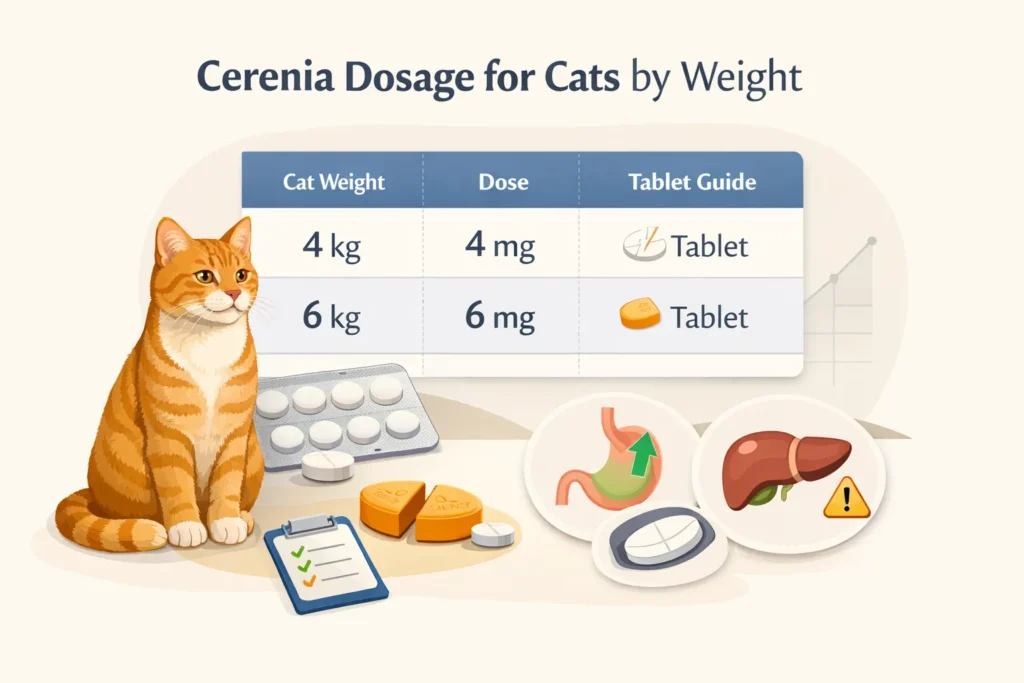
Cerenia Dosage for Cats by Weight
The maropitant dose for cats is always 1 mg/kg once daily, regardless of the reason for use. This chart shows the exact mg dose and the recommended tablet for every common cat weight, including how to split tablets.
| Cat Weight | Dose (1 mg/kg) | Recommended Tablet | Tablet Split | Frequency | Duration (Vomiting) |
|---|---|---|---|---|---|
| 2 kg (4.4 lb) | 2 mg | ½ × 16 mg tablet | Split in half (gives 8 mg). Confirm with vet. | Once daily | Up to 5 days |
| 3 kg (6.6 lb) | 3 mg | ½ × 16 mg tablet | Gives 8 mg. Vet may round up to full tablet. | Once daily | Up to 5 days |
| 4 kg (8.8 lb) | 4 mg | ½ × 16 mg tablet | Gives 8 mg, closest practical dose. | Once daily | Up to 5 days |
| 5 kg (11 lb) | 5 mg | ½ × 16 mg tablet | Gives 8 mg, most common dose in practice. | Once daily | Up to 5 days |
| 6 kg (13.2 lb) | 6 mg | ½ × 16 mg tablet | Gives 8 mg. Confirm via vet. | Once daily | Up to 5 days |
| 7 kg (15.4 lb) | 7 mg | ½ × 16 mg tablet | Gives 8 mg, just under full tablet range. | Once daily | Up to 5 days |
| 8 kg (17.6 lb) | 8 mg | ½ × 16 mg tablet | Exact half tablet dose. | Once daily | Up to 5 days |
| 10 kg (22 lb) | 10 mg | ½–1 × 16 mg tablet | Vet advises half or whole. 16 mg is slightly above. | Once daily | Up to 5 days |
| 12 kg (26.5 lb) | 12 mg | ½ × 24 mg or 1 × 16 mg tablet | Either option is close to calculated dose. | Once daily | Up to 5 days |
| 16 kg (35 lb) | 16 mg | 1 × 16 mg tablet | Exact full tablet. No splitting needed. | Once daily | Up to 5 days |
Liver Disease — Reduced Dose Reference
| Cat Weight | Standard Dose | Liver-Adjusted Dose (50% reduction) | Recommended Tablet | Notes |
|---|---|---|---|---|
| 3 kg (6.6 lb) | 3 mg | ~1.5 mg | ¼ × 16 mg tablet | Very small dose. Compounded liquid may be more accurate. |
| 5 kg (11 lb) | 5 mg | ~2.5 mg | ¼ × 16 mg tablet | Confirm exact approach with vet. Some prefer 4 mg fixed dose. |
| 6 kg (13.2 lb) | 6 mg | ~3 mg | ¼ × 16 mg tablet | Monitor for prolonged sedation or lethargy. |
| 8 kg (17.6 lb) | 8 mg | ~4 mg | ¼ × 16 mg tablet | Blood tests recommended to check liver function during treatment. |
| 10 kg (22 lb) | 10 mg | ~5 mg | ¼–½ × 16 mg tablet | Always vet-guided for hepatic cats. |
- Highlighted row = average adult cat (5 kg / 11 lb), the most common weight in practice.
- Cerenia tablets come in 16 mg, 24 mg, 60 mg, and 160 mg sizes. For cats, 16 mg is the most commonly prescribed. All tablets are scored for easy splitting.
- Why do most cats get 8 mg? Because most cats weigh 3 to 8 kg, and the closest practical tablet is ½ of a 16 mg tablet. This is common practice. The small underdose relative to strict 1 mg/kg is clinically acceptable.
- Cerenia tablets are off-label for cats. The injectable form is FDA-approved for cats. Oral tablets are approved for dogs only, but are widely used off-label in cats at 1 mg/kg by veterinarians worldwide.
- Once a 16 mg tablet is split, use the other half within 2 days. Store unused halves in the original foil packaging at room temperature, protected from light and moisture.
- Liver disease: dose reduced approximately 50% as maropitant is hepatically metabolised via CYP2D15 and CYP3A12 enzymes. Some vets prefer a fixed low dose (e.g. 4 mg/cat) rather than weight-based reduction for hepatic cats.
- Sources: FDA injectable label (Zoetis), Today's Veterinary Practice (Quimby 2020), VCA Animal Hospitals, GoodRx DVM review, Cats.com veterinary review, Catster DVM review.
What Does Cerenia Do for Cats?
Uses, How It Works, Side Effects & Safety
Cerenia (maropitant citrate) is the most effective anti-vomiting medication currently available for cats. But it is also frequently misunderstood. Many owners don't know why vomiting needs to be suppressed (rather than treated), when it's unsafe to use, or how it compares to other options. This guide covers everything.
🧬 What Does Cerenia Do for Cats?
Cerenia is the brand name for maropitant citrate, a neurokinin-1 (NK1) receptor antagonist developed by Zoetis. It works by blocking substance P, a neuropeptide that triggers the vomiting centre in the brain. When substance P is blocked, the signal to vomit is interrupted at its source, making Cerenia highly effective across a wide range of vomiting causes.
Unlike antacids or gut-motility drugs, Cerenia acts centrally in the brain rather than in the digestive tract. This means it works regardless of what's causing the nausea, whether it's motion sickness, chemotherapy side effects, kidney disease toxins, post-surgical nausea, or an upset stomach. It is not a treatment for the underlying cause. It stops the vomiting reflex while your vet diagnoses and treats what's actually wrong.
Vets prescribe Cerenia for cats in these situations:
- Acute vomiting — gastroenteritis, dietary indiscretion, chemotherapy-related nausea, toxin-induced vomiting
- CKD-associated nausea and vomiting — uremic toxins trigger the chemoreceptor trigger zone; Cerenia blocks this pathway effectively
- Motion sickness / travel nausea — off-label use, given 2 hours before travel
- Pre/post-surgical nausea — prevents opioid and anaesthesia-induced vomiting; also provides mild visceral pain adjunct benefit
- Chronic vomiting in IBD or pancreatitis — as part of a multi-drug management plan under vet supervision
⏱️ How Long Does Cerenia Take to Work, and How Long Does It Last?
How quickly Cerenia works depends on the form used. The injectable version begins working within minutes. Oral tablets take longer to absorb.
30 to 60 minutes — tablets begin absorbing
Maropitant reaches detectable plasma levels within 30 to 60 minutes of oral administration. Bioavailability in cats is approximately 50%, which is why the oral dose matches the injectable dose, unlike in dogs, who need double the oral dose to compensate for lower bioavailability.1 to 2 hours — full effect (oral tablets)
Peak plasma concentration is typically reached within 2.5 hours after oral dosing. For motion sickness, give Cerenia 2 hours before travel to ensure full effect during the journey.How long does Cerenia last in cats?
Each dose of Cerenia lasts approximately 24 hours, which is why it's given once daily. The terminal half-life is 13 to 17 hours in cats. This means dosing once every 24 hours maintains continuous anti-nausea coverage. In cats with liver disease, the drug may last longer due to slower hepatic clearance.⚖️ Cerenia vs Other Anti-Nausea Options for Cats
Cerenia is the most commonly used antiemetic for cats, but it's not the only option. Here's how it compares to the main alternatives vets consider:
| Medication | How It Works | Best For | Key Limitation |
|---|---|---|---|
| Cerenia (maropitant) | Blocks substance P at NK1 receptor in brain | Most types of vomiting; CKD nausea; surgical nausea | Prescription only; not suitable if GI obstruction suspected |
| Ondansetron (Zofran) | Blocks serotonin (5-HT3) receptor | Chemotherapy nausea; sometimes used alongside Cerenia | Off-label in cats; less evidence for general vomiting |
| Gabapentin | Calms CNS, sedation, not anti-nausea | Travel anxiety in cats; vet-visit stress | Does not target nausea or vomiting directly |
| Mirtazapine | Antiemetic and appetite stimulant | CKD cats with both nausea and poor appetite | Affects mood and appetite, not a standalone antiemetic |
| Metoclopramide | Dopamine antagonist and gut motility agent | Gastric motility disorders | Less effective for cats than Cerenia; more side effects |
For most cats with acute vomiting, Cerenia is the first-line choice. For CKD cats with poor appetite alongside vomiting, vets often combine Cerenia with mirtazapine.
⚠️ Cerenia Side Effects in Cats
Cerenia is generally very well tolerated in cats. It has one of the better safety profiles among prescription veterinary medications. Side effects are usually mild and short-lived.
- Lethargy or mild drowsiness
- Decreased appetite temporarily
- Hypersalivation / drooling
- Pain/sting at injection site
- Soft stools or mild diarrhoea
- Muscle tremors or ataxia
- Abnormal breathing
- Hematuria (blood in urine)
- Allergic reaction (swelling, hives)
- Prolonged sedation (over 24 hrs)
- Difficulty breathing
- Severe weakness or collapse
- Facial swelling or hives
- Symptoms not resolving after 24 hrs
- No organ toxicity at standard doses
- Long-term use appears safe (pharmacokinetic studies)
- Does not affect kidney function directly
- Monitor liver values with prolonged use
🛡️ When Should Cerenia NOT Be Given to Cats?
Cerenia is safe for most cats, but there are specific situations where it must not be used, or where careful precaution is needed:
- Kittens under 16 weeks — not approved for this age group due to immature liver function
- Pregnant or nursing cats — safety not established; avoid unless benefit clearly outweighs risk
- Liver disease — use with caution; dose should be reduced by 50% as maropitant is hepatically metabolised
- Heart disease — maropitant affects calcium and potassium channels; use cautiously in cats with known cardiac conditions
- Drug interactions — Cerenia is metabolised via CYP450 liver enzymes. Tell your vet if your cat takes antifungals (fluconazole), phenobarbital, amlodipine, diltiazem, fluoxetine, or NSAIDs, as these may interact
Frequently Asked Questions
Cerenia for Cats — FAQ
Answers to the most commonly searched questions about Cerenia dosage, how fast it works, how long it lasts, safety for CKD cats, and when it should not be used.
- 3 to 8 kg cat → ½ × 16 mg tablet (gives 8 mg, closest practical dose)
- 10 to 16 kg cat → 1 × 16 mg tablet
- Liver disease cats → dose reduced approximately 50% by your vet
Get Your Cat's Exact Cerenia Dose
Enter your cat's weight and reason for use. Get the mg dose and tablet recommendation instantly, for free.
Use the Calculator