
Prednisolone Dosage
for Cats Calculator by Weight
Prednisolone dosing in cats varies widely by condition. Enter your cat’s weight and what it’s being treated for — we’ll show the right dose tier, mg range, tablet guidance, and tapering outline your vet will likely follow.
Prednisolone Dose Calculator for Cats
Unlike Cerenia or Gabapentin, prednisolone has distinct dose tiers. Select your cat’s condition — the dose range shifts significantly between anti-inflammatory and immunosuppressive use.
—
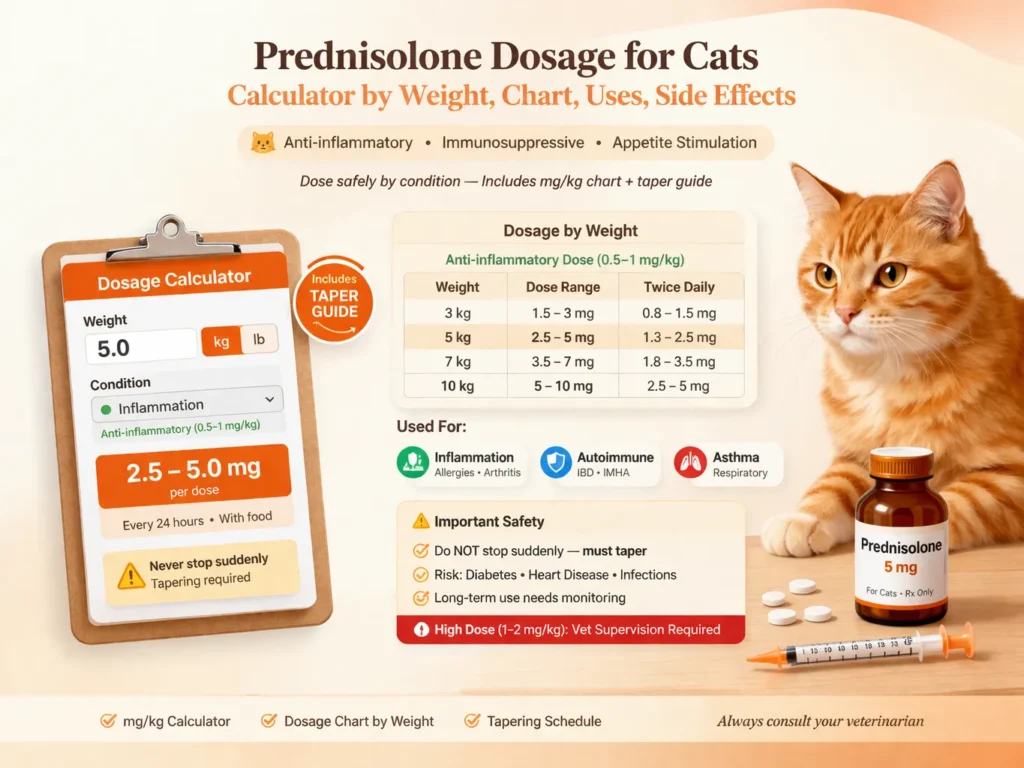
Prednisolone Dosage Chart for Cats by Weight & Condition
Unlike single-dose medications, prednisolone has 3 distinct dose tiers. Select the condition your cat is being treated for to see the appropriate dose range across all common cat weights.
| Weight | lb | Low dose (0.5 mg/kg) | High dose (1 mg/kg) | Tablet suggestion | Notes |
|---|---|---|---|---|---|
| 2 kg | 4.4 | 1 mg | 2 mg | 1–2 × 1mg | Kitten/small cat. 1 mg tablet or liquid. |
| 2.5 kg | 5.5 | 1.25 mg | 2.5 mg | 2.5mg tablet | 2.5 mg tablet is a common exact match |
| 3 kg | 6.6 | 1.5 mg | 3 mg | ½ × 5mg or 2.5mg | Half a 5 mg tablet (2.5 mg) is practical |
| 3.5 kg | 7.7 | 1.75 mg | 3.5 mg | ½ × 5mg | 2.5 mg half tablet covers range |
| 4 kg | 8.8 | 2 mg | 4 mg | ½ × 5mg or 1 × 5mg | 2.5–5 mg range. Vet selects based on severity. |
| 5 kg ★ | 11 | 2.5 mg | 5 mg | ½ or 1 × 5mg | Most common adult weight. 5 mg tablet is standard. |
| 6 kg | 13.2 | 3 mg | 6 mg | 1 × 5mg | 5 mg tablet is the standard practical dose |
| 7 kg | 15.4 | 3.5 mg | 7 mg | 1 × 5mg or 1½ × 5mg | Vet may round to 5 or 7.5 mg |
| 8 kg | 17.6 | 4 mg | 8 mg | 1 × 5mg or 1½ × 5mg | 5–7.5 mg practical dose range |
| Weight | lb | Induction (1–2 mg/kg) | Flat dose (clinical) | Tablet | Notes |
|---|---|---|---|---|---|
| 2 kg | 4.4 | 2–4 mg | 5 mg | 1 × 5mg | Vets often round up to 5 mg flat for ease |
| 3 kg | 6.6 | 3–6 mg | 5 mg | 1 × 5mg | 5 mg/day is commonly used flat dose |
| 4 kg | 8.8 | 4–8 mg | 5 mg | 1 × 5mg | 5 mg is practical standard for most cats |
| 5 kg ★ | 11 | 5–10 mg | 5–10 mg | 1–2 × 5mg | WSAVA: start 1–3 mg/kg. Most vets use 5–10 mg flat. |
| 6 kg | 13.2 | 6–12 mg | 10 mg | 2 × 5mg | 10 mg/day common. Taper after 3–4 weeks. |
| 7 kg | 15.4 | 7–14 mg | 10 mg | 2 × 5mg | 10 mg flat is standard maintenance |
| 8 kg | 17.6 | 8–16 mg | 10 mg | 2 × 5mg or ½ × 20mg | 10–15 mg range. Vet titrates by response. |
| Weight | lb | Standard (1–2 mg/kg) | Severe (2–4 mg/kg) | Tablet | Notes |
|---|---|---|---|---|---|
| 3 kg | 6.6 | 3–6 mg | 6–12 mg | 1–2 × 5mg | Monitor glucose from day 1 at this tier |
| 4 kg | 8.8 | 4–8 mg | 8–16 mg | 1–2 × 5mg | High risk of steroid-induced diabetes at 2+ mg/kg |
| 5 kg ★ | 11 | 5–10 mg | 10–20 mg | 1–2 × 5mg or 1 × 20mg | Lymphoma: 5–10 mg flat dose commonly used |
| 6 kg | 13.2 | 6–12 mg | 12–24 mg | 1 × 5mg + ½ × 20mg | Consider adding chlorambucil for small cell lymphoma |
| 7 kg | 15.4 | 7–14 mg | 14–28 mg | 1 × 20mg or split | Very high doses require specialist oncology oversight |
| 8 kg | 17.6 | 8–16 mg | 16–32 mg | 1–2 × 20mg | Doses above 20 mg/day require close specialist monitoring |
| Weight | lb | Replacement dose | Stress dose (illness) | Tablet | Notes |
|---|---|---|---|---|---|
| 2 kg | 4.4 | 0.2–0.4 mg | 0.6–1.2 mg | Compounded liquid | Liquid necessary. Tablet splitting too imprecise. |
| 3 kg | 6.6 | 0.3–0.6 mg | 0.9–1.8 mg | Compounded liquid | Precise dosing essential. Liquid preferred. |
| 4 kg | 8.8 | 0.4–0.8 mg | 1.2–2.4 mg | Compounded or 1mg tab | 1 mg tablet may still be too large. Consider compounding. |
| 5 kg ★ | 11 | 0.5–1 mg | 1.5–3 mg | 1 × 1mg tablet | 1 mg tablet or compounded liquid |
| 6 kg | 13.2 | 0.6–1.2 mg | 1.8–3.6 mg | 1 × 1mg tablet | Stress dosing: 2–3× normal during illness or surgery |
| 8 kg | 17.6 | 0.8–1.6 mg | 2.4–4.8 mg | Compounded or 1mg tab | Lifelong daily therapy. Monitor annually. |
Tablet Sizes Available
Dosing Principles
Always use Prednisolone, never Prednisone, in cats. Prednisone is an inactive prodrug that must be converted by the liver to prednisolone. Studies show cats have poor hepatic conversion of prednisone. Only approximately 21% reaches active form in cats versus full conversion in dogs. Using prednisone in cats risks therapeutic failure (the drug simply does not work) while still exposing the cat to systemic steroid side effects. All doses in this chart are for prednisolone only.
Clinical References & Safety Notes
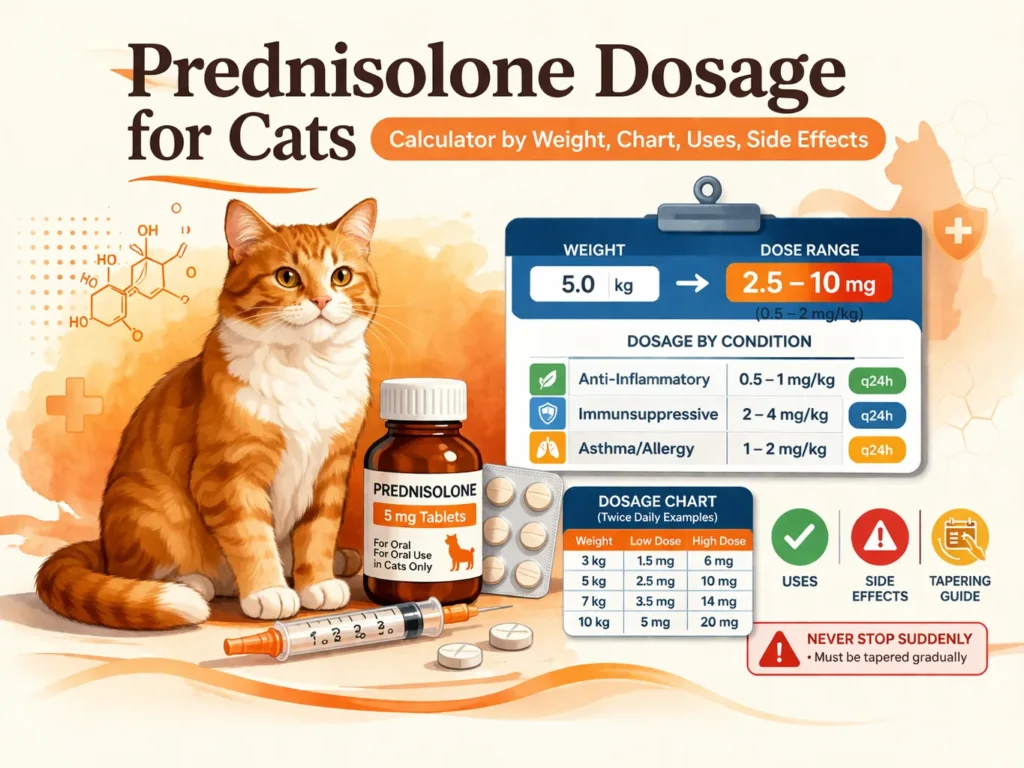
What Is Prednisolone for Cats?
Prednisolone is a synthetic corticosteroid and the most commonly prescribed steroid in feline medicine. It mimics cortisol, a hormone the cat’s adrenal glands produce naturally, but at much higher concentrations to control inflammation or suppress the immune system.
Prednisolone is the active form of the drug. Unlike prednisone (the inactive prodrug), prednisolone does not require liver conversion before it becomes active in the body. This distinction is critical in cats, because feline livers are poor at converting prednisone, making prednisolone the only reliable oral corticosteroid for cats.
It is one of the most versatile drugs in veterinary medicine. At low doses it reduces inflammation. At high doses it suppresses the immune system. At physiologic doses it replaces cortisol the body cannot produce on its own. This extraordinarily wide therapeutic range makes prednisolone both indispensable and potentially dangerous if dosed incorrectly or stopped abruptly.
Anti-inflammatory Action
Blocks production of prostaglandins, leukotrienes, and cytokines. These are the chemical mediators that cause swelling, redness, and pain. Used for allergies, mild asthma, and skin inflammation.
Immunosuppressive Action
At higher doses, prevents immune cells from attacking the body’s own tissues. Used for IBD, autoimmune haemolytic anaemia, and lymphoma, where the immune system is the problem.
Physiologic Replacement
At very low doses, replaces cortisol in cats with Addison’s disease (adrenal insufficiency) whose adrenal glands cannot produce their own. This is lifelong daily therapy.
Prednisolone vs Prednisone for Cats: Why It Matters
These two drugs look almost identical on paper but behave very differently in cats. Getting this distinction wrong can mean the medication simply doesn’t work, while the cat still faces side effects.
This poor bioavailability of prednisone in cats means that giving prednisone instead of prednisolone can result in therapeutic failure. The cat continues to suffer from IBD, asthma, or an autoimmune condition because the drug isn’t reaching adequate plasma concentrations. The systemic side effects (adrenal suppression, metabolic disruption) can still occur even when the drug isn’t working therapeutically. Prednisolone eliminates this problem entirely.
What Is Prednisolone Used For in Cats?
Prednisolone is one of the most versatile drugs in feline medicine. Its uses span from a short 5-day course for a skin allergy to lifelong daily therapy for Addison’s disease.
Inflammatory Bowel Disease (IBD)
The most common long-term use. Prednisolone at 1–3 mg/kg/day reduces GI tract inflammation when the immune system is attacking the gut lining. Response usually seen in 1–2 weeks. Tapering is essential.
Feline Asthma
Prednisolone controls airway inflammation. Best for acute episodes. Long-term oral use is not ideal. Transitioning to inhaled fluticasone (AeroKat spacer) is preferred for chronic management due to lower systemic side effects.
Allergies & Skin Disease
Short courses reduce itching, swelling, and skin inflammation from allergic dermatitis, flea allergy, or eosinophilic granuloma complex. Shortest effective course preferred to minimise side effects.
Lymphoma & Cancer
Prednisolone (5–10 mg/cat/day) is part of treatment for small cell GI lymphoma, usually combined with chlorambucil. For large cell lymphoma, it is used palliatively or in multi-agent protocols. Important: confirm diagnosis before starting. Pre-treatment reduces chemotherapy effectiveness.
Autoimmune Disease
Immune-mediated haemolytic anaemia, autoimmune thrombocytopenia, and lupus-like conditions require high-dose prednisolone (1–2 mg/kg/day or higher) to achieve remission. Additional immunosuppressants may be added.
Addison’s Disease
Very low physiologic doses (0.1–0.2 mg/kg/day) replace the cortisol the adrenal glands fail to produce. Rare in cats. Lifelong daily therapy with stress dosing required during illness or surgery.
Prednisolone Side Effects in Cats
Cats tolerate corticosteroids better than dogs overall, but they are uniquely prone to steroid-induced diabetes, more so than any other species. The risk increases significantly with dose and duration.
- Increased thirst (polydipsia)
- Increased urination (polyuria)
- Increased appetite (polyphagia)
- Mild lethargy or behaviour change
- Soft stools or mild diarrhoea
- Slightly reduced immune response
- Steroid-induced diabetes mellitus (9.7% risk at or above 1.9 mg/kg)
- Weight gain and pot-bellied appearance
- Thin, fragile skin (skin fragility syndrome)
- Thinning haircoat
- Iatrogenic Cushing’s syndrome
- Increased UTI risk (immune suppression)
- Muscle weakness / wasting
- Excessive thirst + weight loss = possible diabetes
- Vomiting blood or black tarry stools (GI ulcer)
- Sudden weakness, collapse (adrenal crisis from abrupt stopping)
- Congestive heart failure (fluid retention)
- Severe infection (immunosuppression)
- Behaviour aggression (“steroid rage”)
- Cats tolerate steroids better than dogs generally
- Fewer glucocorticoid receptors = less systemic sensitivity
- But uniquely higher risk of steroid-induced diabetes
- GI ulceration less common in cats than dogs
- Cats rarely develop skin fragility at standard doses
- More resistant to iatrogenic Cushing’s than dogs
Steroid-induced diabetes: This is the most important feline-specific risk. A 2021 Royal Veterinary College study found that 9.7% of cats on doses at or above 1.9 mg/kg/day for 3 or more weeks developed prednisolone-induced diabetes mellitus. Many cases resolve once prednisolone is tapered or stopped, but not always. Overweight, older, and male cats are at higher risk. Regular blood glucose monitoring is essential in any cat on long-term, high-dose prednisolone.
Prednisolone Safety: When to Use Caution or Avoid
Prednisolone can be used in most cats, but several conditions significantly change the risk-benefit balance.
- Active infections (untreated)Prednisolone suppresses the immune system. Starting it during an active bacterial, fungal, or viral infection without concurrent antibiotic/antifungal treatment allows the infection to spread rapidly. Always treat active infections concurrently or before starting steroids.
- Diabetic catsPrednisolone significantly raises blood glucose, more so in cats than any other species. It should generally not be used in cats with established diabetes unless the benefit is compelling and blood glucose is closely managed with insulin adjustment. A specialist opinion is strongly advisable.
- Pre-diabetic or obese catsOverweight cats and those with a history of elevated glucose are at substantially higher risk of developing steroid-induced diabetes. Use the lowest effective dose, shortest possible duration, and monitor blood glucose from the start.
- Heart disease (HCM, murmurs)Prednisolone causes sodium and fluid retention. In cats with borderline cardiac function, this fluid loading can precipitate congestive heart failure. This risk is highest with injectable depot steroids but oral prednisolone carries some risk too. A pre-treatment cardiac assessment (echocardiogram) may be warranted for cats with known murmurs.
- Cats with Feline Herpesvirus (FHV-1)Immune suppression from prednisolone can reactivate latent FHV-1, causing ocular discharge, sneezing, and ulcerative keratitis. Cats with a known herpesvirus history should be monitored for ocular or respiratory flare-ups during steroid treatment.
- Pregnant catsPrednisolone crosses the placenta and has been associated with fetal abnormalities and abortion in early pregnancy in animal studies. Use only if the benefit to the mother clearly outweighs the risk to the kittens, under close veterinary supervision.
- Young kittensSteroids can impair growth and development in young cats. Avoid unless there is a strong clinical necessity. Short courses at the lowest effective dose are preferred for kittens.
- Cats with kidney disease (CKD)Generally safe and often necessary (e.g., for concurrent IBD). However, immunosuppression increases UTI risk in CKD cats. Monitor urine cultures periodically during long-term prednisolone use.
Prednisolone Drug Interactions in Cats
Tell your vet about all medications, supplements, and herbal treatments your cat receives before starting prednisolone.
| Drug | Risk Level | Interaction |
|---|---|---|
| NSAIDs (meloxicam, aspirin) | High | Greatly increases risk of GI ulceration and bleeding. Avoid combining prednisolone with NSAIDs unless your vet explicitly directs it with GI protectants. |
| Insulin | High | Prednisolone raises blood glucose. Insulin requirements can change significantly. Close glucose monitoring required if both are used. |
| Antifungals (ketoconazole, itraconazole) | High | Inhibit CYP3A4, increasing prednisolone plasma levels and potentially causing steroid toxicity. Monitor closely. |
| Phenobarbital | Moderate | Induces hepatic metabolism and may reduce prednisolone effectiveness. Higher doses may be needed. |
| Diuretics (furosemide) | Moderate | Both can cause electrolyte imbalances. Monitor potassium levels with concurrent use. |
| Vaccines | Moderate | Immunosuppressive doses may reduce vaccine effectiveness. Avoid live vaccines during high-dose steroid therapy. Discuss timing with your vet. |
| Cyclosporine | Moderate | Combined use for immunosuppression may allow lower prednisolone doses. Monitor carefully. Both suppress immunity. |
| Digoxin (cardiac) | Moderate | Steroid-induced hypokalaemia can increase digoxin toxicity. Monitor electrolytes. |
The Most Important Rule: Never Stop Prednisolone Abruptly
This is the single most critical instruction for any cat on prednisolone for more than 1–2 weeks. Abrupt discontinuation can be fatal.
When a cat takes prednisolone for more than 1–2 weeks, the hypothalamic-pituitary-adrenal (HPA) axis suppresses the adrenal glands’ own cortisol production. The body essentially “switches off” its natural hormone factory because an external supply is available. If prednisolone is stopped suddenly, the adrenal glands cannot instantly resume production, leaving the cat without adequate cortisol for days. This can cause acute adrenal insufficiency (Addisonian crisis): vomiting, collapse, severe weakness, dangerously low blood pressure, and death. Always follow your vet’s tapering schedule, even if your cat appears completely recovered.
Frequently Asked Questions: Prednisolone for Cats
Answers to the most common questions about prednisolone dosing, safety, tapering, and side effects in cats, reviewed against veterinary literature.
There is no single “correct” dose because prednisolone has three distinct dose tiers depending on the condition being treated:
- Physiologic (Addison’s replacement): 0.1–0.2 mg/kg/day, very low, mimics natural cortisol
- Anti-inflammatory (allergies, asthma, skin): 0.5–1 mg/kg/day, reduces inflammation
- Immunosuppressive (IBD, autoimmune, lymphoma): 1–2 mg/kg/day, or up to 4 mg/kg/day in severe cases
For a 5 kg cat: anti-inflammatory dose = 2.5–5 mg/day; immunosuppressive dose = 5–10 mg/day. Many vets use a flat 5 mg once daily for IBD regardless of exact weight.
No. Always use prednisolone in cats, not prednisone. This is one of the most important distinctions in feline pharmacology.
Prednisone is an inactive prodrug that must be converted by the liver into prednisolone before it becomes active. Cats have significantly reduced hepatic conversion capacity. Studies show only about 21% of oral prednisone becomes bioavailable prednisolone in cats. The result is that prednisone frequently causes therapeutic failure in cats, where the condition does not improve because the drug isn’t reaching effective plasma concentrations.
Prednisolone, being the active form directly, achieves close to 100% bioavailability in cats. The side effect profile of the two drugs is similar when they do reach equivalent plasma levels. With prednisone in cats, the drug simply often doesn’t work at all.
For IBD, prednisolone is started at an immunosuppressive dose and then tapered. WSAVA guidelines recommend starting at 1–3 mg/kg/day and tapering every 3–4 weeks once clinical remission is achieved.
Many veterinarians use a practical flat dose of 5 mg once daily for most cats, increasing to 10 mg for larger or more severely affected cats. The goal is to taper down to the minimum effective dose, ideally every-other-day dosing, to reduce long-term side effects.
Typical IBD tapering: 5–10 mg daily for 3–4 weeks, then reduce by 25% every 3–4 weeks, then target every-other-day dosing if tolerated.
Prednisolone tablets come in 1 mg, 2.5 mg, 5 mg, and 20 mg sizes. The most commonly used tablet in cats is the 5 mg tablet. It can be given whole (5 mg/day for IBD) or halved (2.5 mg for anti-inflammatory doses in smaller cats).
- 1 mg tablet: Addison’s replacement, very small cats, kittens
- 2.5 mg tablet: Anti-inflammatory doses in 3–5 kg cats
- 5 mg tablet: Standard IBD and allergy dose for most cats
- 20 mg tablet: High immunosuppressive doses in larger cats
- Compounded liquid: Best for cats who resist tablets, very precise doses, or Addison’s replacement
Stopping prednisolone abruptly after more than 1–2 weeks of use can cause acute adrenal insufficiency (Addisonian crisis), a potentially fatal condition.
When a cat takes prednisolone for an extended period, the hypothalamic-pituitary-adrenal axis suppresses the adrenal glands’ natural cortisol production. The body “turns off” its own hormone factory because an external supply exists. If prednisolone is suddenly removed, the adrenal glands cannot immediately resume production. The resulting cortisol deficiency causes severe weakness, vomiting, collapse, dangerously low blood pressure, and potentially death.
The answer depends on what’s being treated:
- Allergies / itchy skin: Relief often begins within 1–2 hours of the first dose. Prednisolone acts quickly on acute inflammation.
- Asthma: Airway inflammation begins to reduce within hours. Full stabilisation takes 1–3 days.
- IBD: GI symptoms typically begin to improve within 1–2 weeks of starting treatment
- Autoimmune disease: May take 2–4 weeks to see significant improvement in blood counts or clinical signs
- Lymphoma: Response may be seen in 1–2 weeks. Reassessment every 4–6 weeks.
For cats, prednisolone is generally given in the evening. This differs from dogs and horses (who receive morning dosing) because cats have a different natural cortisol rhythm. Their cortisol peaks in the evening rather than the morning. Giving prednisolone in the evening more closely aligns with the cat’s natural cycle and minimises disruption to the hypothalamic-pituitary-adrenal axis.
Always give with food to reduce the risk of gastrointestinal irritation. Be consistent and give at the same time every day.
Give the missed dose as soon as you remember. However, never give two doses at once or give two doses closer than 6 hours together.
If it is almost time for the next scheduled dose, skip the missed dose and resume normal dosing. Missing a single dose is unlikely to cause a problem in most cases. However, if your cat has been on prednisolone for an extended period and you miss several doses in a row, contact your vet. especially if signs of the underlying condition return or if the cat shows weakness or vomiting (potential signs of inadequate cortisol).
Yes. This is the most important feline-specific risk of prednisolone. Cats are uniquely susceptible to steroid-induced diabetes mellitus compared to dogs or humans.
A historical cohort study at the Royal Veterinary College (Nerhagen et al., J Feline Med Surg 2021) found that 9.7% of cats receiving prednisolone at doses at or above 1.9 mg/kg/day for 3 or more weeks developed prednisolone-induced diabetes mellitus. This is far higher than the spontaneous feline DM rate of approximately 0.42%.
Risk factors include: high dose, long duration, obesity, older age, and male sex. In many cats, the diabetes resolves once prednisolone is tapered or stopped, but not always.
Generally yes. Prednisolone is often necessary and well-tolerated in cats with CKD, particularly for concurrent conditions like IBD, which is common in senior cats who also have kidney disease.
The primary additional consideration in CKD cats is the increased risk of urinary tract infections. Immune suppression from prednisolone increases UTI risk, and cats with CKD are already more prone to UTIs. Periodic urine cultures are recommended.
Prednisolone does not directly harm the kidneys at standard therapeutic doses. However, the fluid retention effect of steroids should be monitored in cats with advanced CKD. Discuss fluid management with your vet.
Increased thirst (polydipsia) and urination (polyuria) are expected and common short-term side effects of prednisolone. This is caused by the steroid’s effect on the kidneys’ handling of sodium and water, and by the gluconeogenic effect on blood glucose.
However, if the increased thirst and urination are severe or accompanied by weight loss, this may indicate the development of steroid-induced diabetes mellitus rather than a simple steroid effect. Your vet can distinguish them with a blood glucose test and fructosamine level.
Always report significant changes in thirst or urination to your vet when your cat is on prednisolone. Do not assume it’s just the medication without checking.
It depends entirely on the condition. For acute conditions like allergies, the goal is the shortest effective course, typically 5–14 days with tapering. For chronic conditions like IBD, lymphoma, or autoimmune disease, prednisolone may be needed for months or years, sometimes lifelong.
For long-term use, the key principle is always to taper to the minimum effective dose on the least frequent schedule. Many well-controlled IBD cats are eventually maintained on 2.5–5 mg every other day. Some cats cannot be weaned off entirely and require ongoing low-dose maintenance.
Long-term monitoring (every 3–6 months) should include blood glucose, complete blood count, blood pressure, and urinalysis as a minimum.
Yes. Prednisolone and Cerenia (maropitant) are commonly prescribed together, particularly in cats with IBD or pancreatitis who are also vomiting. There are no known significant direct interactions between the two drugs.
Cerenia controls nausea and vomiting through NK-1 receptor antagonism, a completely different mechanism from prednisolone’s glucocorticoid action. The combination is frequently used in cats with IBD and is considered safe and clinically appropriate.
Calculate your cat’s prednisolone dose
Use our weight-based calculator above. Select your cat’s condition and we’ll show the correct dose tier, mg range, tapering schedule, and safety notes.