
Mirtazapine for Cats
Dosage Calculator & Guide
Mirtazapine (Mirataz®) helps cats regain appetite and weight during illness. Enter your cat’s details to get the correct dose, dosing interval, and step-by-step instructions.
Mirtazapine Dose Calculator for Cats
Select the form your vet prescribed, enter your cat’s weight, and tick any applicable conditions. We’ll show the correct dose, interval, and how to administer it.
—
Correct Doses at a Glance
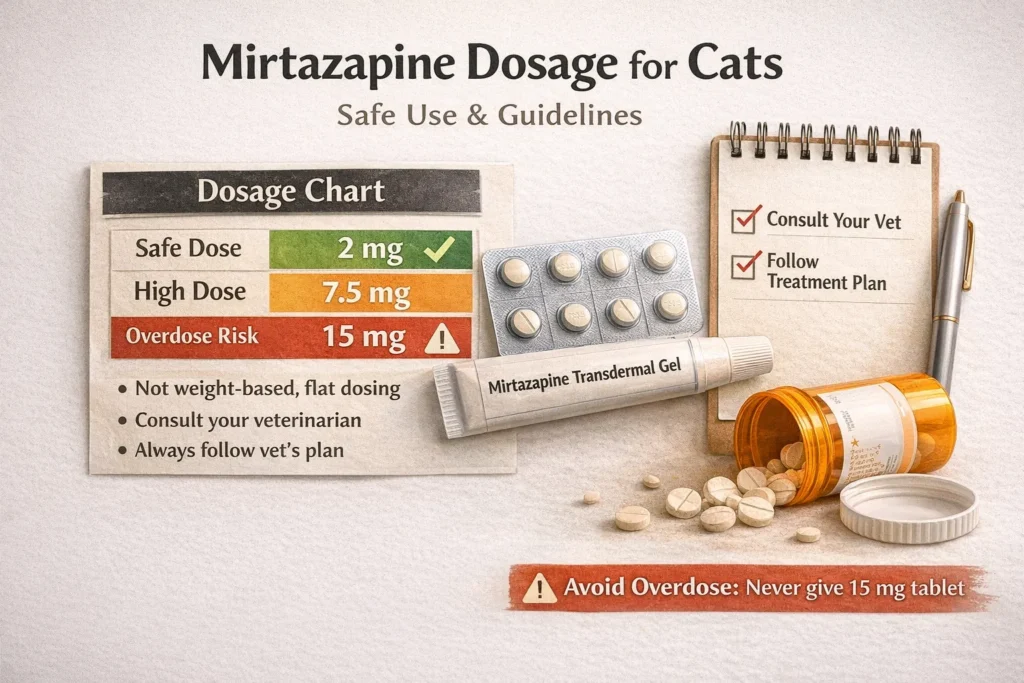
Mirtazapine Dosage Chart for Cats: All Forms and Conditions
Unlike most medications, mirtazapine dosing in cats is flat (not weight-based). Every cat gets the same dose regardless of weight. What changes is the frequency, depending on kidney function, liver health, and age.
| Cat type | Form | Dose | Frequency | Safety level |
|---|---|---|---|---|
| Healthy, adult cat (any weight) | Mirataz® transdermal | 2 mg | Once daily × 14 days | FDA-approved |
| Healthy, adult cat (any weight) | Oral (compounded) | 1.88 mg | Every 24 hours | Evidence-based |
| CKD cat (any stage) | Oral (compounded) | 1.88 mg | Every 48 hours | RCT confirmed |
| Elderly cat (10 years or older) | Oral or transdermal | 1.88–2 mg | Every 48 hours | Caution |
| Liver disease cat | Oral (compounded) | 1.88 mg | Every 48 hours | Monitor LFTs |
| Cat under 2 kg | Any | Consult vet | Not established | Not evaluated |
| Obsolete dose (do not use) | Oral | 3.75 mg | Every 72 hours | More side effects, no benefit |
| Accidental overdose | Oral | 15 mg | Full human tablet | Serotonin toxicity: emergency |
| Cat weight | Weight (lb) | Dose (all cats) | mg/kg equivalent | Small cat note |
|---|---|---|---|---|
| 2 kg | 4.4 lb | 1.88 mg | 0.94 mg/kg | High mg/kg. Vet caution advised. Mirataz not evaluated under 2 kg. |
| 2.5 kg | 5.5 lb | 1.88 mg | 0.75 mg/kg | Lowest range of Quimby 2011 pharmacokinetic study |
| 3 kg | 6.6 lb | 1.88 mg | 0.63 mg/kg | Within well-studied range |
| 3.5 kg | 7.7 lb | 1.88 mg | 0.54 mg/kg | Standard range |
| 4 kg ★ | 8.8 lb | 1.88 mg | 0.47 mg/kg | Common adult weight. FDA reference cat ~4 kg (9 lb). |
| 4.5 kg ★ | 9.9 lb | 1.88 mg | 0.42 mg/kg | FDA reference: Mirataz ~0.5 mg/kg for 4 kg cat |
| 5 kg | 11 lb | 1.88 mg | 0.38 mg/kg | Most common adult weight. Dose unchanged. |
| 6 kg | 13.2 lb | 1.88 mg | 0.31 mg/kg | Larger cat. Dose still the same flat 1.88 mg. |
| 8 kg | 17.6 lb | 1.88 mg | 0.24 mg/kg | Large cat. Flat dose. No dose increase needed. |
What makes mirtazapine unusual
Dosing interval decisions
Never use human mirtazapine tablets (7.5 mg, 15 mg, 30 mg, 45 mg) to dose your cat at home. The cat dose (1.88 mg) is less than one quarter of the smallest commercial tablet (7.5 mg). The ASPCA poison control study found 40 out of 84 cat toxicity cases involved accidental ingestion of a full 15 mg tablet. Even a small sliver of a tablet may contain many times the correct feline dose. Always use a compounded formulation at the exact 1.88 mg dose. Source: Ferguson LE et al., J Feline Med Surg 2016;18(11):868–874.
What Is Mirtazapine for Cats? (Mirataz)
Mirtazapine is a prescription medication used in cats as an appetite stimulant and anti-nausea agent. The brand Mirataz® (transdermal ointment) is the first and only FDA-approved medication specifically for weight loss management in cats.
Originally developed as a human antidepressant, mirtazapine is used in veterinary medicine not for its antidepressant properties but for two specific pharmacological effects: it stimulates appetite and reduces nausea. These properties make it valuable for cats with chronic conditions, particularly kidney disease, liver disease, cancer, and inflammatory bowel disease, where nausea and inappetence cause progressive weight loss.
Mirataz® received FDA approval for cats in May 2018, making it the first feline-specific product for managing unintended weight loss. Before this, veterinarians used compounded oral mirtazapine off-label, and this practice continues alongside Mirataz.
Appetite Stimulation
Blocks the 5-HT2C receptor in the hypothalamus. This receptor normally inhibits appetite. Blocking it removes the brakes on hunger signalling. It also blocks H1 (histamine) receptors which further promotes appetite. Effect is seen within hours.
Anti-nausea Effect
Antagonises 5-HT3 receptors, the same receptor targeted by ondansetron. Blocking this receptor in the chemoreceptor trigger zone prevents nausea signals from triggering vomiting. This is why mirtazapine helps cats with CKD-related nausea.
Noradrenergic Effect
Also blocks alpha-2 adrenergic receptors, increasing norepinephrine activity. This contributes to appetite stimulation and may have mild prokinetic (gut motility) effects. This unique combination of mechanisms gives mirtazapine its broad clinical utility.
What Is Mirtazapine Used For in Cats?
Mirtazapine is used whenever a cat’s chronic illness is causing weight loss through reduced appetite or nausea, regardless of the specific underlying disease.
Chronic Kidney Disease (CKD)
Most common use. CKD causes nausea, vomiting, and inappetence through uremic toxin accumulation. A placebo-controlled RCT (Quimby & Lunn, Vet J 2013) showed mirtazapine at 1.88 mg q48h produced significant appetite increase, weight gain, and reduction in vomiting in CKD cats vs placebo.
Inflammatory Bowel Disease (IBD)
IBD-related nausea and inappetence respond well to mirtazapine’s dual antiemetic and appetite-stimulating action. Often used alongside prednisolone for IBD management. The two drugs work through completely different mechanisms and are safe to combine.
Cancer and Chemotherapy
The FDA-approved Mirataz indication specifically includes weight loss due to chemotherapy and chronic illness. Mirtazapine helps cancer patients maintain weight and appetite during treatment, improving quality of life. It is an important adjunct to oncological care.
Liver Disease and Hepatic Lipidosis
Liver disease causes profound nausea. Hepatic lipidosis (fatty liver) is an urgent condition where restoring appetite is life-saving. Mirtazapine may assist in managing inappetence while other treatments address the underlying liver pathology. Use with caution (q48h interval) due to prolonged drug half-life in liver disease.
Unexplained Weight Loss
The Mirataz FDA indication is “body weight gain in cats with a history of weight loss.” It can be used to support nutritional status while underlying causes of weight loss are being investigated and treated.
Post-surgical and Post-hospitalisation
Cats who have been unwell or hospitalised often have suppressed appetite on return home. A short course of mirtazapine can help restore eating behaviour. The transdermal form is particularly useful here, as cats who are reluctant to eat are also often reluctant to accept oral medication.
Mirtazapine Side Effects in Cats
Side effects are strongly dose-related. At the current evidence-based dose (1.88–2 mg), most cats tolerate mirtazapine well. The older 3.75 mg dose caused significantly more adverse effects without any additional benefit. Any sign of unusual behaviour after a dose should prompt a call to your vet.
- Vocalisation (meowing/calling), especially in first 1 to 2 hours
- Hyperactivity or restlessness (mild)
- Increased affection and clinginess
- Application site reaction (Mirataz): redness, crusting, residue at ear (~10% of cats)
- Sedation or drowsiness
- Vomiting (paradoxically, in some cats)
- Excessive loud vocalisation (crying, distress)
- Severe agitation or extreme restlessness
- Tremors or muscle rigidity
- Rapid or laboured breathing
- Rapid heart rate (tachycardia)
- Hyperthermia (overheating)
- Seizures or collapse
After stopping mirtazapine: Monitor your cat’s food intake carefully. The Mirataz FDA label specifically requires owners to monitor eating after the drug is stopped. If food intake falls below 25% of normal for several days, or your cat stops eating for more than 48 hours, contact your vet. The appetite may temporarily drop after discontinuation as the drug effect wears off. This is expected and not the same as the underlying disease returning, though the underlying condition still requires management.
Mirtazapine Drug Interactions in Cats
Always tell your vet every medication, supplement, and herbal product your cat is taking before starting mirtazapine. The serotonergic interactions are particularly important.
| Drug / Drug class | Risk | Why it matters |
|---|---|---|
| MAOIs (selegiline / Anipryl, amitraz) | Contraindicated | Life-threatening serotonin syndrome. Mirtazapine must not be started within 14 days before or after any MAOI. This is an absolute contraindication on the Mirataz FDA label. |
| SSRIs (fluoxetine / Prozac, sertraline) | High Risk | Both increase serotonin activity. Combining them significantly raises serotonin syndrome risk. Avoid co-administration unless specifically directed by a veterinary internal medicine specialist. |
| Tramadol | High Risk | Tramadol inhibits serotonin re-uptake. Combining with mirtazapine increases serotonin syndrome risk, especially in older or debilitated cats. |
| Trazodone | High Risk | Another serotonergic agent. Combining with mirtazapine increases risk of CNS and cardiovascular effects consistent with serotonin excess. |
| Cyproheptadine | Avoid (cancels effect) | Cyproheptadine is a serotonin antagonist used as the antidote for mirtazapine toxicity. When used concurrently with therapeutic mirtazapine, it cancels the appetite-stimulating effects entirely. Do not use together. Source: Ferguson et al. 2016. |
| Opioids (buprenorphine, morphine) | Caution | Combined sedation effect. Mirtazapine and opioids together may cause more sedation or respiratory depression than either alone. Use with caution and monitor. |
| Diazepam / benzodiazepines | Caution | Enhanced sedation. Mirtazapine’s sedative properties are additive with benzodiazepines. |
| Human transdermal medications | Human safety | People handling Mirataz without gloves may absorb mirtazapine through their own skin. This is especially relevant for children and people already taking antidepressants. Always wear gloves and observe the 2-hour no-contact period after application. |
Who Should Not Use Mirtazapine: Contraindications and Cautions
Based on the FDA label, ASPCA toxicity data, and veterinary pharmacokinetic studies, here are the established safety boundaries for mirtazapine in cats.
- Known hypersensitivity to mirtazapineAbsolute contraindication per Mirataz FDA label. If your cat has had an allergic reaction to mirtazapine previously, do not re-administer.
- Concurrent MAOI use (or within 14 days of MAOI)Absolute contraindication. MAOIs include selegiline (Anipryl), which is used for feline cognitive dysfunction. Life-threatening serotonin syndrome can result. The 14-day washout period is mandatory.
- Cats under 6 months of ageMirataz safety has not been evaluated in cats younger than 6 months. Do not use in kittens without explicit veterinary guidance.
- Pregnant, breeding, or lactating catsSafety has not been evaluated in reproductive cats. Avoid use without specific veterinary justification and oversight.
- Cats under 2 kgMirataz has not been evaluated in cats weighing less than 2 kg (FDA label). For very small cats, the standard 2 mg dose represents a higher mg/kg exposure. Discuss with your vet whether dosing should be adjusted.
- Liver disease (hepatic dysfunction)Mirtazapine is hepatically metabolised. Cats with liver disease show prolonged half-life and Tmax. Use every-48-hour dosing (not daily) and monitor liver enzyme values. Source: Fitzpatrick et al., J Vet Intern Med 2018.
- Kidney disease (CKD)Mirtazapine can and should be used in CKD cats. It is well-studied and beneficial. But dosing frequency must be reduced to every 48 hours. CKD cats have 39% higher drug exposure than healthy cats at the same dose. Source: Quimby JM et al., J Vet Intern Med 2011.
- CKD cats: safe at correct intervalThe Quimby & Lunn 2013 RCT specifically included CKD cats (Stage II–IV) and showed mirtazapine at 1.88 mg q48h was safe and effective, producing significant appetite increase and weight gain without significant adverse effects.
Monitoring Your Cat During and After Mirtazapine
Mirtazapine does not require formal laboratory monitoring for most cats, but attentive home observation is important, especially after discontinuation.
After stopping Mirataz or oral mirtazapine: The FDA label specifically requires monitoring of food intake after discontinuation. Watch for these warning signs: eating less than 25% of normal for several consecutive days, or complete refusal to eat for more than 48 hours. Either of these warrants a call to your vet. This is not always because the underlying disease has worsened. Sometimes the appetite simply needs time to stabilise without the drug. But it is important to rule out deterioration.
During treatment: No specific blood testing is required for healthy cats on a 14-day Mirataz course. For cats on long-term oral mirtazapine (especially those with CKD, liver disease, or multiple medications), your vet may recommend periodic liver enzyme checks and a general health assessment every 3–6 months.
What to watch for at home: Monitor food and water intake daily. Weigh your cat weekly on a kitchen scale if possible. Weight trends are the best marker of whether the treatment is working. Signs of excessive sedation, loud vocalisation, or behavioural agitation should prompt a call to your vet. Even at the correct dose, a small number of cats experience side effects. These are manageable with prompt communication with your vet.
Application site (Mirataz): Check the inner ear pinna at each dose application. About 10% of cats develop local skin reactions including redness, crusting, or scabbing. If this occurs, wipe the ear clean before the next application and inform your vet. Alternating ears helps minimise this.
Frequently Asked Questions: Mirtazapine for Cats
Answers to the most common questions cat owners ask about mirtazapine dosing, timing, the Mirataz patch, CKD dosing, side effects, and what to do if something goes wrong.
Unlike most medications, mirtazapine in cats is flat-dosed. The same dose regardless of weight:
- Mirataz® transdermal (FDA-approved): A 1.5-inch ribbon (~2 mg) applied to the inner ear pinna once daily for 14 days
- Oral mirtazapine (off-label, healthy/adult cats): 1.88 mg by mouth every 24 hours
- Oral mirtazapine (CKD, elderly, or liver disease cats): 1.88 mg by mouth every 48 hours (every other day)
The older 3.75 mg every-72-hour dose has been shown to cause significantly more adverse effects than 1.88 mg without any greater appetite stimulation. Source: Quimby JM et al., J Vet Pharmacol Ther 2011; Ferguson et al., J Feline Med Surg 2016.
Mirataz® is the brand name for the only FDA-approved feline mirtazapine product. It is a transdermal ointment applied to the inner ear flap, not a pill. The ointment contains 20 mg/g mirtazapine; a 1.5-inch ribbon delivers approximately 2 mg per dose.
Key differences from oral mirtazapine: Mirataz has FDA approval specifically for cats (oral mirtazapine is off-label); Mirataz has a lower peak plasma concentration (Cmax) than oral at equivalent doses, which may mean fewer side effects; Mirataz is much easier to administer to cats who are sick and refusing oral medication.
The older 3.75 mg every-72-hour (every 3 days) dose was historically used before the pharmacokinetic data was well established. Current evidence shows this dose causes significantly more adverse effects than 1.88 mg without any greater appetite stimulation.
Today’s Veterinary Practice (2019, authored by Dr. Jessica Quimby, who led the key studies) states that the evidence “indicates that a lower dose of 1.88 mg every 24 hours (every 48 hours in cats with chronic kidney disease) is equally effective at appetite stimulation” with fewer side effects. The 3.75 mg dose “should be discarded in favour of the 1.88 mg dose.”
If your cat has been prescribed 3.75 mg q72h, it is worth discussing current dosing recommendations with your vet at the next visit. Do not change the dose without vet direction, but it is a reasonable conversation to have.
This is extremely risky and strongly discouraged. Human mirtazapine tablets come in 7.5 mg, 15 mg, 30 mg, and 45 mg. The feline dose is 1.88 mg, which is less than a quarter of the smallest commercial tablet. Attempting to cut 1/4 of a 7.5 mg tablet or 1/8 of a 15 mg tablet by hand or with a pill splitter will not produce a reliable 1.88 mg dose.
The ASPCA Animal Poison Control Center study of 84 feline mirtazapine toxicity cases found the most common cause was accidental ingestion of a full 15 mg tablet (40 cats). Even well-intentioned manual splitting creates dangerous dose variability. A licensed compounding pharmacy can prepare 1.88 mg capsules or oral liquid at the correct concentration. This is the safe option for oral administration. Source: Ferguson LE et al., J Feline Med Surg 2016.
The dose amount stays the same (1.88 mg) but the frequency changes to every 48 hours (every other day) instead of every 24 hours. This is one of the most important adjustments in feline mirtazapine dosing.
CKD cats have significantly reduced mirtazapine clearance. A pharmacokinetic study (Quimby JM et al., J Vet Intern Med 2011) found their drug exposure (AUC) was 39% higher than healthy cats at the same dose, and elimination half-life was extended from 12 to 15 hours. Daily dosing in CKD cats causes drug accumulation over time, substantially increasing the risk of adverse effects. The every-48-hour schedule was validated in a placebo-controlled clinical trial (Quimby & Lunn, Vet J 2013) specifically in CKD cats and shown to be both safe and effective.
Yes. Mirtazapine and Cerenia (maropitant) are commonly used together in cats with CKD or IBD, and there are no significant known direct pharmacokinetic interactions between the two. They work through completely different mechanisms (mirtazapine at 5-HT3 and H1 receptors; Cerenia at NK-1 receptors) and complement each other’s antiemetic and appetite-stimulating effects.
This combination is regularly used in feline internal medicine practice for cats with CKD suffering from concurrent nausea and inappetence. Always confirm with your vet before combining medications, but this is a well-established and safe co-prescription for appropriate patients.
Mirtazapine typically begins stimulating appetite within a few hours of the first dose. Most owners observe measurably increased interest in food within the first 24 to 48 hours. The Mirataz FDA label states the medication should take effect within 1 to 2 days.
With the transdermal ointment (Mirataz), absorption is through the skin and slightly slower than oral, but clinically effective levels are reached within a few hours of application. Steady-state plasma concentrations are achieved within the 14-day treatment course.
Vocalisation is one of the most commonly reported side effects of mirtazapine in cats and was documented as a common adverse event in both the ASPCA toxicity study and the Mirataz clinical trials. It typically occurs in the first 1 to 2 hours after administration and usually resolves on its own.
Mild vocalisation at therapeutic doses is expected and not a cause for panic. However, excessive, distressed, or prolonged vocalisation (lasting more than a few hours) may indicate the dose is too high for your cat and should be reported to your vet. If accompanied by tremors, rapid breathing, or extreme agitation, treat this as a potential overdose reaction and contact your vet or an emergency clinic.
A reduction in appetite after stopping mirtazapine is specifically addressed in the FDA Mirataz label. It is a known and expected effect. The label requires veterinarians to instruct owners to monitor food intake after discontinuation.
Some reduction in appetite after stopping the drug is common and expected as the drug’s stimulating effect wears off. However, there are thresholds that require veterinary contact: if your cat is eating less than 25% of their normal amount for several consecutive days, or stops eating entirely for more than 48 hours, call your vet.
This is distinct from the underlying disease. The appetite drop after stopping mirtazapine can be partly due to the drug effect wearing off, and partly a return of the underlying condition. Your vet will help distinguish the two and advise whether to restart the medication or pursue other management.
Call immediately. Do not wait for symptoms:
ASPCA Animal Poison Control: 1-888-426-4435
Pet Poison Helpline: 1-855-764-7661
Or go directly to your nearest emergency vet clinic.
Try to identify which tablet was ingested (7.5 mg, 15 mg, 30 mg, 45 mg), approximately how much was eaten, and your cat’s weight. This information helps poison control assess the severity.
Signs of mirtazapine overdose typically begin within 15 minutes to 3 hours: vocalisation, agitation, vomiting, unsteady walking, tremors, rapid heartbeat, hyperthermia, and in severe cases seizure or collapse. Most cases resolve with treatment within 12 to 48 hours. The antidote is cyproheptadine (2–4 mg/cat), administered by a vet.
The most dangerous scenario is a cat ingesting a full human 15 mg, 30 mg, or 45 mg tablet. This is far above the therapeutic dose and requires emergency treatment immediately.
Call your vet immediately and let them know what happened, including the form (transdermal or oral), dose given, and time of each dose. Do not wait to see if symptoms develop.
Two 1.88 mg oral doses together is 3.76 mg, which is close to the 3.75 mg dose that ASPCA data shows causes significantly more adverse effects than the 1.88 mg dose in many cats. Two Mirataz doses applied together would represent approximately 4 mg.
Signs to watch for in the hours after a double dose: excessive vocalisation, agitation, vomiting, unsteady gait, tremors, rapid breathing, hyperthermia. If any of these appear, go to an emergency vet. The antidote is cyproheptadine, only available through a veterinarian.
At therapeutic doses (1.88–2 mg), mirtazapine’s safety record in clinical trials is good. The ASPCA toxicity study of 84 cases did not report deaths as a common outcome. The vast majority of cats with mirtazapine toxicity recovered within 12 to 48 hours with supportive treatment.
However, deaths related to mirtazapine in cats do occur in specific circumstances:
- Accidental ingestion of large doses (e.g., a full 15 mg or 30 mg human tablet) causing severe serotonin syndrome with extreme hyperthermia and cardiovascular collapse, particularly without emergency treatment
- A cat who was already critically ill from an underlying disease (cancer, end-stage CKD, cardiac failure) where any physiological stress can overwhelm a fragile system
- Delay in emergency treatment: serotonin syndrome that would be treatable with prompt cyproheptadine and supportive care can become life-threatening if left untreated for many hours
- MAOI interaction: combining mirtazapine with a monoamine oxidase inhibitor causes catastrophic serotonin syndrome that can be fatal
If your cat has died after receiving mirtazapine and you believe the dose was correct, the cause was most likely the underlying disease rather than the drug itself. You can report adverse events to FDA at 1-888-FDA-VETS.
Mirtazapine is generally compatible with prednisolone (steroids), most antibiotics, antacids (famotidine, omeprazole), phosphate binders used in CKD, and cerenia (maropitant). These combinations are routinely used together in feline medicine.
Drugs that should not be combined with mirtazapine or require caution:
- MAOIs (selegiline/Anipryl): absolute contraindication, 14-day washout needed
- SSRIs (fluoxetine, sertraline): high serotonin syndrome risk, avoid if possible
- Tramadol: increases serotonin syndrome risk
- Cyproheptadine: cancels mirtazapine’s appetite-stimulating effects entirely
- Sedatives and opioids: enhanced sedation
Always tell your vet everything your cat is receiving, including flea/tick treatments, supplements, and human medications your cat may have accidentally accessed.
Check the mirtazapine dose for your cat
Use our calculator above. Select the form (Mirataz or oral), enter your cat’s weight, and flag any special conditions like CKD or liver disease for the correct dosing interval.