
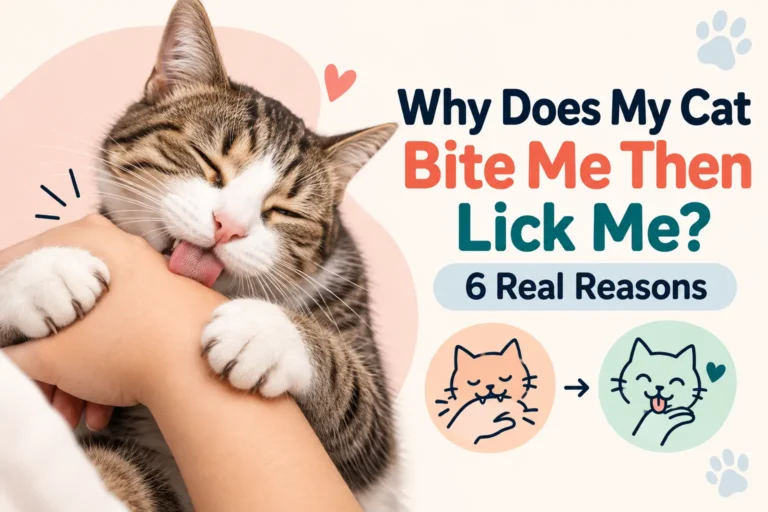
Quick answer: A cat that bites you and then licks you is usually treating you like another cat. The most common reasons are grooming behavior, gentle love bites during bonding, play instincts, and overstimulation from petting. It rarely signals aggression. Watch the ears and tail: relaxed body means affection, twitching tail and flat ears mean stop petting.
You are petting your cat, everything feels peaceful, and then it happens. A quick nip on your hand, followed immediately by licking the same spot. It seems contradictory. Did your cat just attack you or apologize to you?
Neither. Your cat is communicating in cat language, and once you translate it, the bite then lick combination makes complete sense. Here are the six real reasons, ordered from most to least common.
6 reasons your cat bites then licks you
1. Your cat is grooming you
This is the most common reason. When cats groom each other, a behavior called allogrooming, they use both teeth and tongue. The small nibbles work through tangles and reach spots the tongue cannot clean alone, and the licking finishes the job. Cats only groom individuals they consider family. If your cat nibbles your hand or arm and then licks it with a relaxed body, you just received the full family grooming treatment.
2. Love bites during bonding
Gentle, controlled bites that do not break skin are a genuine sign of affection. Kittens learn them with their littermates, and adult cats keep them for individuals they trust. A love bite comes with soft eyes, a loose body, and often purring. It is pressure without intent to hurt.
3. Overstimulation from petting
Cats have a petting threshold. Repetitive stroking builds static like sensation, and when a cat hits its limit, it bites to say “enough.” The lick that follows is a softener, the cat’s way of ending contact without conflict. This is called petting induced aggression, and the warning signs almost always come first: a twitching tail tip, skin rippling along the back, flattened ears, and a quick head turn toward your hand. Stop petting at the first twitch and the bite never happens.
4. Play behavior
Cats play by stalking, pouncing, grabbing, and biting, because play is rehearsal for hunting. A cat in play mode may grab your hand, bite it, kick it with the back legs, and lick it in between. Young cats do this the most. The fix is never your hands: redirect every play bite to a wand toy or kicker toy so your cat learns hands are for petting only.
5. Attention seeking
Some cats learn that a nip gets an instant reaction when meowing gets ignored. If your cat bites then licks you while you work or scroll your phone, and then leads you somewhere, the message is “pay attention to me.” It works the same way as the demand meowing we covered in why cats meow so much: whatever you do right after the bite teaches your cat whether biting works.
6. Taste and scent
The least dramatic reason. Salty skin after a workout, lotion, or food residue can make your arm genuinely interesting. The nibble and lick are simple investigation, not communication.
Affection bite or warning bite? How to tell
| Signal | Affection (keep bonding) | Warning (stop petting) |
|---|---|---|
| Bite pressure | Gentle, no skin broken | Sharp, sudden, harder |
| Tail | Still or slow sway | Twitching or thumping tip |
| Ears | Forward and relaxed | Flattened or turned back |
| Body | Loose, leaning into you | Tense, skin rippling |
| Sound | Purring or quiet | Low growl or silence after purring stops |
| After the bite | Stays with you, keeps licking | Moves away or stares at your hand |
Body language is the reliable signal here, more than the bite itself. Our guide to cat sounds and what they mean covers the vocal side of these warnings, like the growl that sometimes comes before a real bite.
🐱 Not sure what your cat meant?
Enter the sound and body language you observed and our free Cat Language Translator gives you the most likely meaning instantly.
Try the Cat Language TranslatorHow to respond to bite then lick behavior
- For grooming and love bites, do nothing. This is bonding. Enjoy it. If the nibbles are harder than you like, calmly withdraw your hand and offer a toy instead. Never punish affection.
- For overstimulation, learn your cat’s limit. Count how many strokes trigger the tail twitch, then stop one or two strokes before it. Many cats prefer short petting sessions around the cheeks and chin over long strokes down the back.
- For play biting, redirect every single time. The moment teeth touch skin, go still, then swap in a proper toy. Movement rewards the bite, stillness ends the game. Consistency for two to three weeks retrains most cats.
- Never yell or swat. Punishment teaches fear, not rules, and fearful cats bite harder. Withdrawal of attention is the only penalty a cat understands.
When biting needs a closer look
Bite then lick is almost never a medical issue, but a few changes deserve attention:
- A gentle cat suddenly biting hard can signal pain. Cats hide illness, and biting when touched in one specific spot is a classic pain sign worth a vet visit.
- Biting during petting in a senior cat that never did it before can point to arthritis or skin sensitivity.
- Bites that break skin need washing with soap and water right away. Cat bites carry bacteria deep into tissue, so see a doctor if the wound swells, reddens, or throbs within 24 hours.