
Benadryl Dosage for Cats
Calculator by Weight
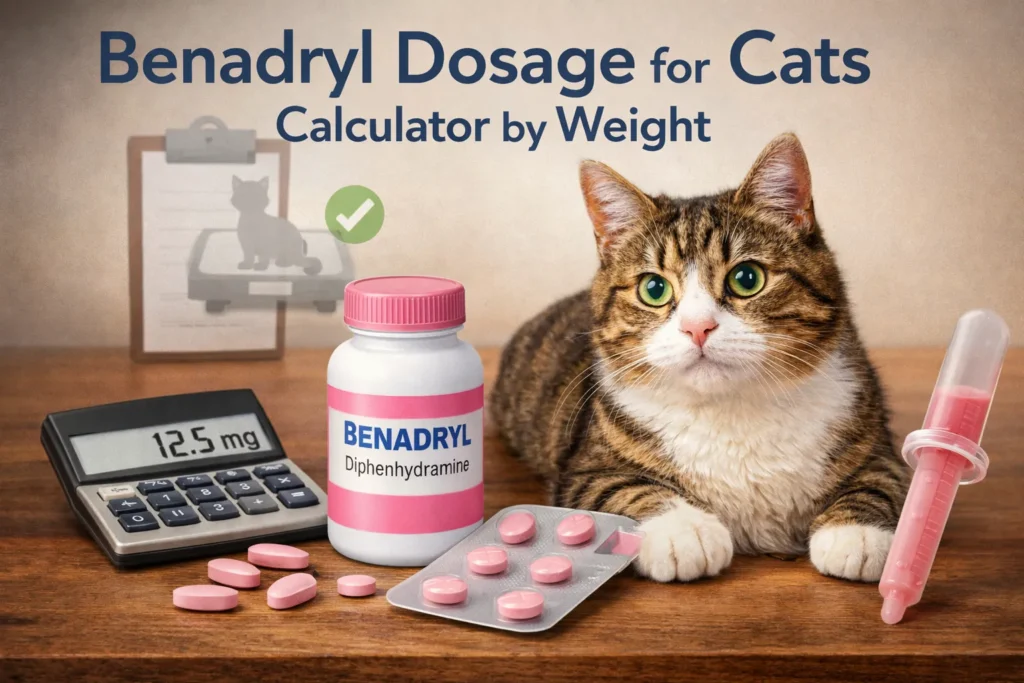
Benadryl (diphenhydramine) can help cats with allergies, insect reactions, and mild motion sickness. Enter your cat’s weight to get the mg dose, tablet fraction, and liquid volume, plus the one safety check that matters most.
Benadryl Dosage Calculator for Cats
Enter your cat’s weight and select the reason for use. We’ll calculate the mg dose, show the right tablet fraction to use, and give the liquid volume if you’re using Children’s Benadryl liquid.
Standard Benadryl tablets are 25 mg. Most cats need only a fraction. A pill splitter helps. Confirm the tablet only contains diphenhydramine HCl before giving.
Use Children’s Benadryl liquid (12.5 mg/5 mL). Use an oral syringe for accurate measurement. Confirm the liquid contains only diphenhydramine. No xylitol, no other active ingredients. Most cats dislike the taste. Mixing with a small amount of food may help.
—
Benadryl Dosage Chart for Cats by Weight
Quick-reference chart showing Benadryl (diphenhydramine) dose in mg, tablet fraction, and liquid volume for every common cat weight. The 5 kg / 11 lb row is highlighted as the most common adult cat weight.
| Weight (kg) | Weight (lb) | Dose (mg) | 25 mg tablet | 12.5 mg tablet | Liquid (12.5mg/5mL) | Frequency |
|---|---|---|---|---|---|---|
| 1.5 kg | 3.3 lb | 3.3 mg | 1/8 tablet | 1/4 tablet | 1.3 mL | Every 8–12 hrs |
| 2 kg | 4.4 lb | 4.4 mg | ~1/6 tablet | 1/3 tablet | 1.8 mL | Every 8–12 hrs |
| 2.5 kg | 5.5 lb | 5.5 mg | ~1/4 tablet | ~1/2 tablet | 2.2 mL | Every 8–12 hrs |
| 3 kg | 6.6 lb | 6.6 mg | ~1/4 tablet | 1/2 tablet | 2.6 mL | Every 8–12 hrs |
| 3.5 kg | 7.7 lb | 7.7 mg | ~1/3 tablet | ~2/3 tablet | 3.1 mL | Every 8–12 hrs |
| 4 kg | 8.8 lb | 8.8 mg | ~1/3 tablet | ~3/4 tablet | 3.5 mL | Every 8–12 hrs |
| 4.5 kg | 9.9 lb | 9.9 mg | ~2/5 tablet | ~3/4 tablet | 4.0 mL | Every 8–12 hrs |
| 5 kg ★ | 11 lb | 11 mg | ~1/2 tablet | ~1 tablet | 4.4 mL | Every 8–12 hrs |
| 5.5 kg | 12.1 lb | 12.1 mg | ~1/2 tablet | 1 tablet | 4.8 mL | Every 8–12 hrs |
| 6 kg | 13.2 lb | 13.2 mg | ~1/2 tablet | 1 tablet | 5.3 mL | Every 8–12 hrs |
| 7 kg | 15.4 lb | 15.4 mg | ~2/3 tablet | 1.25 tablet | 6.2 mL | Every 8–12 hrs |
| 8 kg | 17.6 lb | 17.6 mg | ~3/4 tablet | 1.5 tablet | 7.0 mL | Every 8–12 hrs |
Available Forms
Dosing Rules
Always check that the product contains ONLY diphenhydramine HCl. Benadryl-D and all “D” formula antihistamines contain pseudoephedrine, a decongestant that is highly toxic to cats and can cause seizures, cardiac arrhythmias, and death. Some liquid Benadryl products also contain xylitol, which is toxic. Read the full ingredients list, not just the front of the box. If you are not 100% certain the product is plain diphenhydramine only, do not give it. Contact your vet or pharmacist.
What Is Benadryl (Diphenhydramine) for Cats?
Benadryl is the brand name for diphenhydramine hydrochloride, a first-generation antihistamine used off-label in cats to reduce allergic symptoms, motion sickness, and mild sedation.
Diphenhydramine works by blocking H1 histamine receptors, preventing histamine from binding to cells and triggering the symptoms of an allergic reaction (itching, swelling, sneezing, hives). It also has anticholinergic effects (drying secretions, mild sedation) and weak antiemetic properties.
Unlike some medications, diphenhydramine is not FDA-approved for cats. Its use in feline patients is entirely off-label. Veterinarians prescribe it based on established clinical experience, and it is listed in standard veterinary references including VCA Animal Hospitals, the Merck Veterinary Manual (1 to 2 mg/kg for hypersensitivity reactions), and Wedgewood Pharmacy. Consult your vet before giving it to your cat.
What Is Benadryl Used For in Cats?
Benadryl has several legitimate uses in cats. Knowing when it is appropriate and when it is not enough is important for safe use.
Allergic reactions: itching, hives, swelling
The most common use. Benadryl reduces histamine-driven symptoms from environmental allergens, flea bites, food reactions, and contact allergens. Treats symptoms only and does not address the underlying cause.
Insect bites and stings
Useful for mild reactions to bee stings, wasp stings, or spider bites. Can reduce local swelling and itching. If the reaction progresses to difficulty breathing or collapse (anaphylaxis), go to an emergency vet immediately. Benadryl cannot treat anaphylaxis.
Vaccine reactions (pre-treatment)
Cats with a history of mild vaccine reactions may be given Benadryl 30 to 60 minutes before a vaccine appointment to reduce the risk of a repeat reaction. Always discuss with your vet first. They may prefer to administer it at the clinic.
Motion sickness (mild)
May reduce nausea during car travel in some cats. Effectiveness varies considerably. Some cats experience paradoxical excitation rather than sedation. Gabapentin or Cerenia are generally more reliable for travel-related nausea or anxiety.
Mast cell tumour management
Diphenhydramine is part of the histamine-blocking protocol for cats with mast cell tumours (MCT), which release large amounts of histamine. Used as part of a broader oncology treatment plan under veterinary supervision.
Anxiety: not recommended
While Benadryl causes drowsiness in some cats, its sedative effect is mild and unreliable for anxiety. Many cats experience paradoxical excitation instead. Gabapentin (5 to 10 mg/kg, 1.5 to 2 hours before the event) is significantly more effective for vet visits, car travel, or fireworks.
Benadryl Side Effects in Cats
Diphenhydramine is generally well-tolerated at the correct dose in healthy cats. The most important cat-specific side effect to know about is paradoxical excitation.
- Drowsiness or sedation (most common)
- Dry mouth. Ensure water access.
- Mild GI upset: vomiting, reduced appetite
- Urinary retention (difficulty urinating)
- Paradoxical excitation: hyperactivity, agitation in some cats
- Extreme sedation or stupor
- Seizures or tremors
- Rapid or irregular heart rate
- Respiratory depression (slow, laboured breathing)
- High body temperature
- Dilated pupils
Paradoxical excitation is a unique and important cat-specific effect. Unlike dogs or humans who typically become drowsy on diphenhydramine, some cats become unusually agitated, hyperactive, or vocal. This occurs because of cats’ different CNS receptor profile compared to other species. If your cat becomes more restless or agitated after Benadryl, stop giving it and contact your vet.
Benadryl Safety: Who Should Not Use It
Diphenhydramine has specific contraindications in cats that are important to check before giving it.
- GlaucomaDiphenhydramine has anticholinergic effects that increase intraocular pressure. In cats with glaucoma, this can accelerate permanent vision damage. Do not give Benadryl to a cat with a glaucoma diagnosis.
- Heart disease or cardiac arrhythmiasDiphenhydramine affects cardiac conduction and can worsen arrhythmias or increase heart rate. Not recommended for cats with known heart disease or heart murmurs without explicit vet clearance.
- History of urinary blockageThe anticholinergic effects of diphenhydramine can cause urinary retention. In male cats prone to urethral obstruction, this can trigger a potentially life-threatening blockage. Avoid unless vet confirms it is safe.
- HyperthyroidismDiphenhydramine may exacerbate hyperthyroid symptoms. Use with caution and inform your vet if your cat is being treated for hyperthyroidism.
- High blood pressure (hypertension)Diphenhydramine can raise blood pressure. Use with caution in hypertensive cats and only after vet clearance.
- Seizure disordersHigh doses of antihistamines can lower the seizure threshold. Use with caution in cats with epilepsy or a history of seizures.
- Pregnant or nursing queensHigh doses of diphenhydramine have been shown to cause birth defects in laboratory animals. It is excreted in breast milk. Use only if benefits clearly outweigh risks and under vet supervision.
- Kittens under 6 months oldSafety is not established in very young kittens. Do not give Benadryl to kittens under 6 months of age without specific veterinary guidance.
- Healthy adult cats (with vet confirmation)Benadryl at 1 mg/lb every 8 to 12 hours is generally well-tolerated in healthy adult cats. Always confirm with your vet before giving, especially the first time.
Benadryl vs Gabapentin for Cat Anxiety: Key Differences
Many owners reach for Benadryl when their cat is anxious for travel or vet visits. Gabapentin is generally the better choice. Here’s why.
Multiple veterinary sources (Whisker, Cats.com, Innovet) note that Benadryl is not the preferred medication for feline anxiety. If your cat needs anxiety management for vet visits, car travel, or stressful events, ask your vet about a one-time gabapentin dose. It is significantly more effective and better-tolerated for this purpose.
When Benadryl Is NOT Enough: Recognising Anaphylaxis
Benadryl treats mild to moderate allergic reactions. A severe systemic allergic reaction (anaphylaxis) requires emergency veterinary care. Benadryl alone cannot save a cat in anaphylactic shock.
Signs of mild to moderate reaction (Benadryl may help): Localised swelling (e.g., near a sting or bite), mild hives, itching, sneezing, watery eyes. Monitor closely and contact your vet.
Signs of anaphylaxis (emergency, go to vet immediately): Difficulty breathing or open-mouth breathing, extreme facial swelling (especially lips, throat, eyes), sudden extreme lethargy or collapse, pale or blue-tinged gums, seizures, severe vomiting or diarrhoea starting rapidly. Do not wait to see if Benadryl works. Go directly to an emergency vet. These signs can progress to death within minutes without epinephrine and supportive care.
Benadryl for Cats: Frequently Asked Questions
Answers to the most common questions about giving Benadryl (diphenhydramine) to cats, including dosing, safety, what to avoid, and when to call a vet.
Yes. Diphenhydramine (Benadryl) is considered generally safe for healthy adult cats when given at the correct dose and in the right formulation. It is used off-label in cats for allergic reactions, mild itching, insect bites, and motion sickness.
However, always confirm with your vet first, especially if it is the first time, your cat has any health conditions, or is on other medications. Certain conditions (glaucoma, heart disease, urinary blockage history) make Benadryl unsafe.
The standard veterinary dose is 1 mg per pound of body weight (approximately 2 mg/kg). For example:
- 6 lb cat: 6 mg per dose
- 8 lb cat: 8 mg per dose
- 10 lb cat: 10 mg per dose
- 12 lb cat: 12 mg per dose
Give every 8 to 12 hours as needed. Do not give more than 3 doses in any 24-hour period. Use our calculator above to get the exact amount for your cat’s weight.
Use Children’s Benadryl liquid at a concentration of 12.5 mg per 5 mL. The formula is:
mL = (cat’s weight in lbs × 5) ÷ 12.5
Examples:
- 6 lb cat: 6 mg needed, 2.4 mL
- 8 lb cat: 8 mg needed, 3.2 mL
- 10 lb cat: 10 mg needed, 4.0 mL
Use an oral syringe for accurate measurement. Most cats dislike the taste. You can mix it with a very small amount of food or use a pill pocket alternative.
Not a whole one. That would be far too much for most cats. A standard Benadryl tablet is 25 mg. Most cats weigh between 8 to 12 lb and need only 8 to 12 mg per dose, meaning you’d use roughly a third to half of a 25 mg tablet.
For small cats (under 8 lb), a 25 mg tablet is very difficult to split accurately enough. In those cases, the 12.5 mg tablet or the liquid formulation gives you a more precise dose.
Every 8 to 12 hours as needed, with a maximum of 3 doses per 24 hours. Do not give doses closer than 8 hours apart.
For ongoing allergies, Benadryl can be given regularly up to 3 times daily. However, cats can develop tolerance to antihistamines over time. If it stops working as well, discuss alternative antihistamines with your vet. Chlorpheniramine is another commonly used option in cats.
No. Benadryl-D is toxic to cats. Benadryl-D contains pseudoephedrine, a decongestant that is highly dangerous to cats and dogs. Even small amounts can cause seizures, cardiac arrhythmias, extreme agitation, high blood pressure, and death.
This applies to any antihistamine with a “D” in the name (Claritin-D, Zyrtec-D, Allegra-D, etc.). The “D” always means pseudoephedrine or a similar decongestant.
Not without vet clearance. Diphenhydramine has anticholinergic effects that can interfere with cardiac conduction and may worsen arrhythmias or raise heart rate. Cats with heart disease, cardiomyopathy, or arrhythmias are at increased risk of adverse cardiac effects.
Contact your vet before giving Benadryl to a cat with any diagnosed heart condition. There may be safer alternatives for whatever you’re trying to treat.
Not to kittens under 6 months old. Safety has not been established in very young kittens. Their livers are still developing and they metabolise drugs differently than adult cats.
If your kitten has an allergic reaction or is itching, contact your vet directly. They can recommend a safe approach for a young cat. Do not guess a dose for a kitten based on weight alone.
An overdose of diphenhydramine in cats can cause:
- Extreme sedation, stupor, or unresponsiveness
- Seizures or tremors
- Rapid or irregular heart rate
- High body temperature (hyperthermia)
- Dilated pupils
- Respiratory depression (slow, laboured breathing)
- Paradoxical severe agitation
If you suspect an overdose, call your vet or the ASPCA Animal Poison Control Center at 1-888-426-4435 immediately. Do not wait for symptoms to appear. Act as soon as you know too much was given.
Benadryl typically takes effect within 30 minutes to 1 hour after giving it. The effects usually last 8 to 12 hours, though this varies from cat to cat.
For motion sickness or travel anxiety, give the dose 30 to 60 minutes before the journey begins so it is working by the time you depart.
You can try it, but it often doesn’t work well. Benadryl’s sedative effect in cats is mild and unreliable. Many cats show little or no sedation, and some become more agitated (paradoxical excitation) rather than calmer.
Gabapentin is the better option for vet visit or travel anxiety in cats. Given at 5 to 10 mg/kg approximately 1.5 to 2 hours before the event, it provides reliable sedation and reduces stress. It requires a vet prescription, so ask your vet ahead of time. Multiple studies and veterinary behaviour specialists now recommend gabapentin as first-line for feline travel and vet anxiety.
It depends on how severe the reaction is:
- Mild reaction (localised swelling near a bite or sting, mild itching, sneezing, hives with no breathing difficulty): Benadryl is appropriate as a first step. Give the correct dose, monitor closely, and call your vet to report what happened.
- Moderate reaction (swelling spreading, vomiting, lethargy): give Benadryl and head to the vet. Don’t wait to see if it improves.
- Severe reaction or anaphylaxis (difficulty breathing, facial swelling especially around mouth and throat, collapse, seizures, pale or blue gums): skip the Benadryl and go directly to an emergency vet. Anaphylaxis requires epinephrine and IV support. Benadryl cannot treat it fast enough.
Cats notoriously dislike the taste of diphenhydramine liquid. Some options that work:
- Hide a tablet fragment in a small amount of wet food: tuna, pâté, or a pill pocket treat. Use just enough food to mask the pill.
- Pill gun or piller: a small plastic device that places the pill at the back of the throat without fingers. Many cats accept this better than manual pilling.
- Liquid via oral syringe: if using liquid, draw up the correct amount and squirt gently into the side of the mouth (between cheek and teeth, not directly down the throat). Follow with a treat immediately.
- Ask your vet about compounded formulations: some pharmacies can make diphenhydramine in a flavoured formulation (chicken, tuna) that is much easier to give.
Most cats dislike the taste of diphenhydramine liquid. Hiding it in food is the most commonly successful approach.
This is called paradoxical excitation, and it is more common in cats than in most other species. Instead of becoming sedated, some cats become hyperactive, agitated, vocal, or restless after taking diphenhydramine.
It happens because of how cats’ central nervous system receptors respond to anticholinergic drugs differently from dogs or humans. It is not a sign of overdose (unless combined with other overdose symptoms). It is just an individual response that some cats have.
If your cat experiences this, stop giving Benadryl. It will simply not be effective or appropriate for your cat. Discuss alternatives with your vet. The excitation usually resolves within a few hours as the drug wears off.
Only products where diphenhydramine HCl is the sole active ingredient. Safe options include:
- Benadryl Allergy (plain diphenhydramine tablets, 25 mg)
- Benadryl Children’s Allergy liquid (diphenhydramine 12.5 mg/5 mL)
- Generic diphenhydramine tablets (12.5 mg or 25 mg)
- Vetadryl: veterinary formulation of diphenhydramine
Not safe:
- Benadryl-D (contains pseudoephedrine: toxic)
- Any “non-drowsy” formula (typically contains different antihistamines or decongestants)
- Any combination cold/allergy product (multiple active ingredients)
- Liquid formulas containing xylitol. Check ingredients list, not just the front of the box.
- Gel capsules: contain solvents that may cause irritation or toxicity in cats
Same active ingredient, different branding. Vetadryl is a veterinary-labelled form of diphenhydramine. It contains the same drug (diphenhydramine HCl) as plain Benadryl, just formulated and marketed specifically for pets.
The dose is identical: 1 mg per pound. The advantage of Vetadryl is that it only contains diphenhydramine. You don’t need to check the label for dangerous additional ingredients the way you do with human OTC Benadryl products.
Yes. Reducing itch from allergic reactions is one of the most appropriate uses of Benadryl in cats. It blocks histamine receptors and can relieve itching caused by insect bites, environmental allergens, hives, and mild allergic skin reactions.
However, Benadryl only treats the symptom (itching), not the cause. If your cat is chronically itchy, scratching constantly, or has skin lesions, they need a vet visit to identify and treat the underlying problem. This could be flea allergy dermatitis, food allergy, ringworm, mites, or another skin condition. Giving Benadryl long-term without a diagnosis can mask symptoms and delay appropriate treatment.
Calculate the exact Benadryl dose for your cat
Enter your cat’s weight in our calculator above to get the mg dose, tablet fraction, and liquid volume, plus use-case guidance and safety checks.