
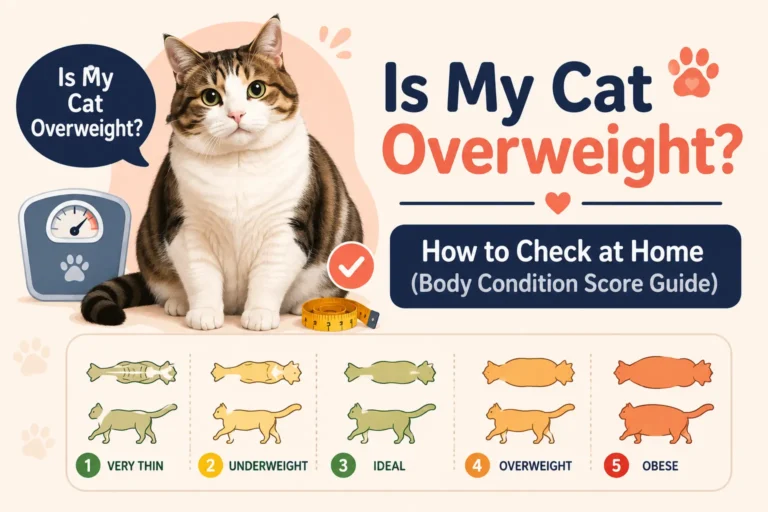
Short answer: You can check right now by feeling your cat’s ribs, looking at their waist from above, and checking their belly from the side. If the ribs are hard to find through a thick fat layer and there is no visible waist, your cat is likely carrying excess weight. The most accurate at-home method is the Body Condition Score (BCS), a 1 to 9 scale used by vets worldwide.
The number on the scale does not always tell the full story. Two cats can weigh exactly the same and be in completely different condition. One may be carrying dense muscle while the other is carrying fat. That is why vets use Body Condition Score rather than weight alone, and why it is worth knowing how to do a quick check at home between vet visits.
This guide walks you through how to assess your cat’s BCS in a few minutes, what the scores actually mean, and what to do next whether your cat is a little round or genuinely underweight.
What Is a Cat Body Condition Score?
A Body Condition Score is a hands-on visual assessment of how much body fat your cat is carrying. It runs on a 1 to 9 scale where 1 is severely emaciated and 9 is severely obese. Scores of 4 and 5 are considered ideal for most adult cats.
Unlike a weigh-in, BCS accounts for the fact that cats vary enormously by breed, frame size, and muscle mass. A large-framed Maine Coon at 6 kg may be perfectly healthy. A small-framed Siamese at the same weight may be obese. BCS cuts through that by focusing on fat coverage and body shape rather than a number on the scale.
It is the same method your vet uses at every check-up, and it is easy to replicate at home once you know what to feel for.
How to Check Your Cat’s Body Condition Score at Home
You do not need a scale or any special equipment. Find a calm moment while your cat is relaxed or being petted and work through these three checks in order.
Place your palms flat on either side of your cat’s chest and slide your fingers gently along the rib cage. At a healthy weight you should feel individual ribs easily with light pressure, similar to feeling the back of your knuckles. If you have to press firmly before you feel anything, a thick fat layer is likely present and that is a sign of excess weight. If you can see the ribs without touching at all, your cat may be underweight.
Stand over your cat and look straight down. A cat at a healthy weight will show a visible waist, a gentle inward curve behind the rib cage that creates a subtle hourglass shape. If the sides appear straight or bulge outward, your cat is likely overweight. If the waist looks dramatically pinched and the spine is very prominent, they may be too thin.
Crouch down to your cat’s level and look at them from the side. A healthy cat’s abdomen will tuck gently upward between the rib cage and the hind legs. If the belly hangs low, sags, or looks rounded when viewed from the side, excess abdominal fat is likely present. This side-view check is especially useful for cats who carry most of their weight around the middle.
Run all three checks together for the most accurate picture. If you are unsure or your cat resists being handled, your vet can do a formal BCS assessment at the next visit and it takes less than a minute.
Our Cat BMI and BCS Calculator walks you through the same checks above and gives you a score, an ideal weight range, and a safe weight-loss timeline.
What Your Cat’s BCS Score Actually Means
Once you have a rough sense of where your cat falls, here is what each part of the scale looks like in practice.
Ribs, spine, and hip bones are visually obvious and feel sharp to the touch with little or no fat covering them. The waist is severely pinched and the abdomen looks tucked and hollow. Cats in this range typically need veterinary attention to rule out illness, parasites, or underlying disease.
Ribs are easily felt with a thin layer of fat over them. They are not visible but not buried either. There is a clear waist behind the rib cage when viewed from above and a gentle abdominal tuck from the side. This is the target range for most adult cats.
Ribs are still findable but require noticeable pressure to feel through a soft fat layer. The waist is less defined or absent when viewed from above and there may be a slight belly sag from the side. This is the most common range for indoor cats and the most actionable. A gradual diet adjustment can bring most cats back to ideal.
Ribs are difficult or impossible to feel. The waist has disappeared and the body looks uniformly rounded from above. The abdomen hangs low and may sway when the cat walks. Fat deposits may be visible around the face, limbs, and lower back. Cats in this range should see a vet before starting any weight-loss plan, since rapid weight loss in cats can cause hepatic lipidosis, a serious liver condition.
Does My Cat’s Saggy Belly Mean They Are Overweight?
Not necessarily. Most cats have a primordial pouch, a loose flap of skin with a small fat pad that hangs from the lower belly. It is a completely normal anatomical feature found in cats of all sizes, breeds, and fitness levels. Wild cats are thought to have evolved it to protect vital organs during fights and to allow full extension of the hind legs when running at speed.
The way to tell the difference: reach gently into the pouch area and feel the fat pad just in front of your cat’s hind legs. At a healthy weight it should feel small, roughly the size of a kiwi fruit. If the fat pad is noticeably large and firm, or if the entire pouch area looks very full and rounded, that points to excess abdominal fat rather than a normal primordial pouch. The rib and waist checks above will confirm it either way.
Why Cat Obesity Is Worth Taking Seriously
Overweight cats are at significantly higher risk for diabetes, arthritis, urinary disease, and chronic kidney disease (CKD). All of these reduce quality of life and are expensive to manage over time. Studies suggest that nearly 60% of domestic cats in the US are overweight or obese, which makes it easy to normalise what is actually a genuine health risk.
Senior cats carry particular risk. If your cat is over 10 years old, their calorie needs have likely dropped while their risk for thyroid disease and kidney disease has increased. Understanding where they sit on the BCS scale becomes even more important. Our 🕐 Cat Age Calculator can help you identify your cat’s life stage and the health priorities that come with it.
The good news is that a BCS of 6 or 7, the most common overweight range, is very correctable with consistent measured feeding and modest increases in activity. You do not need to put your cat on a crash diet. Slow and steady is both safer and more effective.
What to Do If Your Cat Is Overweight
The three levers for healthy cat weight loss are calorie reduction, portion control, and increased activity. None of them require dramatic changes. Small consistent adjustments over several weeks produce lasting results.
Start with calories, not just food type
Most cats become overweight simply because they are eating more than they need, often through free feeding or generous portion sizes. Use our 🔥 Cat Calorie Calculator to find your cat’s daily calorie target for weight loss. It uses the RER formula, accounts for body condition, and gives you a safe weekly loss timeline.
Measure portions precisely
Switching from eyeballing to measuring food is one of the most effective changes you can make. Our 🍽️ Cat Food Calculator converts your cat’s daily calorie target into exact grams, cups, or cans for wet food, dry food, or a mixed diet. It takes around two minutes to set up and removes the guesswork from every meal.
Increase water intake
Cats eating dry food often drink far less water than they need, which can add stress to the kidneys over time. Shifting toward wet food naturally increases hydration. Our 💧 Cat Water Calculator works out exactly how much water your cat needs after accounting for the moisture already in their food.
Add structured play
Two 10-minute play sessions per day using a wand toy, laser pointer, or crinkle balls can meaningfully increase your cat’s daily energy expenditure. Cats are sprint hunters by nature, so short intense bursts tend to work better than long slow activity sessions.
Always involve your vet for BCS 8 or 9
If your cat scores in the obese range, get a vet assessment before starting a weight-loss plan. Cutting calories too aggressively in an overweight cat can trigger hepatic lipidosis. Your vet can prescribe a structured plan and monitor progress safely.
Weight-loss mode included. Gets you from BCS to a concrete daily food amount in under 2 minutes.
What to Do If Your Cat Is Underweight
An underweight cat scoring BCS 1 to 3 warrants a vet visit sooner rather than later. Cats rarely lose significant weight without a reason. Dental pain, hyperthyroidism, CKD, parasites, stress, and other underlying conditions are all common causes, and the scale alone will not tell you which one it is.
In cats recovering from illness or with very poor appetite, vets sometimes prescribe mirtazapine as an appetite stimulant. If your vet has gone that route, our 🍗 Mirtazapine Dosage Calculator gives you the correct dose by weight with the right dosing interval (q24h for healthy cats and q48h for CKD patients).
For underweight cats without a medical cause such as young rescues or very picky eaters, increasing calorie density through high-protein wet food is usually the first step. Use the 🔥 Cat Calorie Calculator in weight-gain mode to find a safe daily target.
Frequently Asked Questions
Use the Body Condition Score method. Feel your cat’s ribs with light finger pressure (they should be easy to find), look at your cat from above for a waist curve behind the rib cage, and check from the side for an upward belly tuck. If the ribs are buried under fat and the waist has disappeared, your cat is overweight. No scale required. Our Cat BMI and BCS Calculator guides you through each check and gives you a score.
There is no single answer because healthy weight varies significantly by breed, frame size, and sex. A small-framed female Siamese may be perfectly healthy at 3.5 kg while a large-framed male Maine Coon may be ideal at 7 to 8 kg. Rather than chasing a fixed number, aim for a BCS of 4 to 5 where ribs are easily felt, a waist is visible from above, and there is a gentle belly tuck from the side. Our BCS Calculator gives you a personalised ideal weight range based on your cat’s current body condition.
Not necessarily. The loose flap of skin on your cat’s lower belly is called the primordial pouch and it is completely normal in cats of all sizes and body conditions. It exists in wild cats too and is thought to protect organs and allow full leg extension while sprinting. To tell whether your cat’s belly is a normal primordial pouch or genuine excess fat, feel the fat pad inside the pouch area just in front of the hind legs. At a healthy weight it will feel small, roughly kiwi-sized. A large firm fat pad suggests excess abdominal fat. The rib and waist checks in this guide will confirm.
Weight loss in cats should be gradual, around 0.5% to 1% of body weight per week. Losing weight faster than this risks hepatic lipidosis, a serious liver condition triggered when a cat’s body metabolises fat reserves too quickly. Use our Cat Calorie Calculator to find a safe daily calorie target in weight-loss mode, then use our Cat Food Calculator to translate that into exact food portions. Always check with your vet before starting a weight-loss plan if your cat scores BCS 8 or 9.
For most cats, activity alone is not enough to produce meaningful weight loss. The calorie deficit created by play is simply too small compared to what food contributes, so a diet change is almost always necessary. That said, increasing play from zero to two 10-minute sessions per day does support weight loss, reduces food-seeking behaviour, and improves muscle tone which helps your cat maintain a healthy BCS over time. The best approach combines both: reduce portions using measured feeding and add regular structured play.
A BCS of 6 out of 9 is technically classified as overweight, corresponding to roughly 10 to 20% above ideal body weight. It is also the most common score in indoor cats, which is partly why it can seem normal. At BCS 6, ribs are still findable but require moderate pressure and the waist is less defined. The good news is that a BCS-6 cat is in the most responsive range for weight correction. Consistent portion control with our Cat Food Calculator can typically bring them back to ideal within a few months.
Yes. Cats over 10 years old have lower calorie needs and are at higher risk for muscle loss (sarcopenia), which can make them appear thin even when they are carrying a healthy amount of fat. For senior cats, vets sometimes accept a BCS of 5 to 6 rather than pushing for a leaner 4 to 5, especially if the cat has CKD or other chronic conditions where maintaining body mass matters. Use our Cat Age Calculator to understand your cat’s life stage, and discuss individual weight targets with your vet since weight management in seniors needs more nuance than it does in younger adults.
Every four to six weeks is a practical routine for most cat owners and it takes less than two minutes once you know what to feel for. More frequent checks every two weeks are useful when actively managing weight loss so you can adjust portions if progress stalls or moves too fast. Your vet will also assess BCS at every annual check-up. Ask them to share the score they assign so you can calibrate your own at-home assessment over time.
Disclaimer: This guide is for general educational purposes only and does not replace professional veterinary advice. Body Condition Score is a useful screening tool but is not a substitute for a formal examination. If you have concerns about your cat’s weight, appetite, or overall health, consult a licensed veterinarian.