
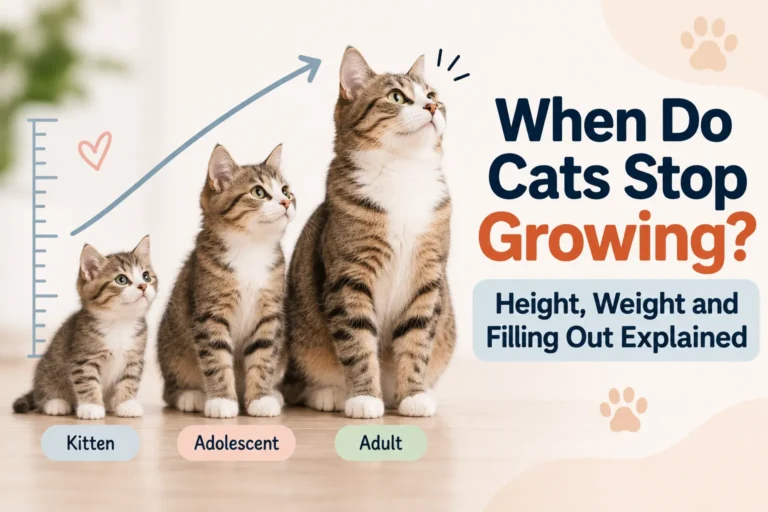
Quick answer: Most cats finish getting taller and longer somewhere between 10 and 18 months. Weight and muscle often keep climbing until about 2 or 3 years, and big breeds like Maine Coons and Ragdolls can take 3 to 4 years to fully mature. Females usually wrap up a little sooner than males, and cats neutered young can grow slightly longer because their growth plates close later.
Somewhere around the eight month mark, most owners notice something odd. The kitten has stopped looking like a kitten, but it does not look like a proper cat either. Long legs, a skinny middle, ears that seem a size too big. You start wondering if this is it, or if there is more coming.
There is usually more coming. The tricky part is that “growing” means three different things in a cat, and they do not all finish on the same day.
Three kinds of growing that finish at different times
Height and length come from the skeleton. The long bones in your cat’s legs have soft areas near the ends called growth plates, and the bones lengthen from there. Once the plates close, the bones are done. For a typical domestic cat that happens somewhere between 10 and 18 months, and no amount of extra food will make a cat taller after that.
Weight is the one you can watch week to week. Kittens gain fast, then it slows down, and a lot of cats keep adding a little for another year or two as their frame settles.
Filling out is the part people miss. A cat can reach its full height at 12 months and still look like a teenager, narrow in the chest and light in the shoulders. Muscle and body shape keep developing for a good while after the bones have finished, which is why a two year old often looks noticeably sturdier than the same cat did at one.
A rough timeline for a typical domestic cat
Treat these numbers as a ballpark, not a pass or fail test. Healthy kittens vary a lot, and a litter of five can easily show a pound of difference between siblings.
| Age | Typical weight | What is happening |
|---|---|---|
| Birth | 3 to 4 oz (about 100 g) | Tiny, eyes closed, doubles its weight in roughly the first week or two |
| 8 weeks | 1.5 to 2.5 lb | Weaned, active, usually heading to its first home around now |
| 4 months | 3 to 5 lb | Fast growth, adult teeth starting to come in |
| 6 months | 5 to 7 lb | Looks grown up, still lanky, most of the height gain is behind it |
| 9 months | 6 to 9 lb | Adolescent phase, growth slowing down |
| 12 months | 7 to 10 lb | Many cats are close to full height and length |
| 18 months | 8 to 12 lb | Most average sized cats are done, muscle still building |
| 2 to 4 years | Varies by breed | Large breeds finish filling out |
If you want a broader look at how those early months play out, we are putting together a week by week kitten growth guide and a kitten weight chart you can check your own cat against.
Breed changes the schedule more than anything else
A Singapura and a Maine Coon are both cats, but they run on very different calendars. Smaller breeds can wrap up around 9 months, while the giants keep going long after most owners have stopped checking.
| Cat type | Usually done growing by |
|---|---|
| Singapura and other small breeds | About 9 to 12 months |
| Domestic shorthair, tabby, Siamese | 12 to 18 months |
| Bengal | About 2 years |
| Savannah | About 2 years |
| Ragdoll | 3 to 4 years |
| Maine Coon | 3 to 4 years |
| Norwegian Forest Cat | 3 to 4 years |
Maine Coon owners get asked this question constantly, and a plain “four years” does not tell the whole story. The skeleton may be mostly done by 18 months or so, but the chest, skull and coat keep broadening for years. We are writing a separate Maine Coon growth chart for exactly that.
Boys, girls and the neutering effect
Males generally end up bigger and take longer to get there. Females often finish around 10 to 12 months, while males can keep going toward 18 months.
Neutering adds a small twist. Sex hormones are part of what tells growth plates to close, so cats neutered early tend to have those plates stay open a bit longer and can end up slightly longer in the leg. A long running study funded by the Winn Feline Foundation followed kittens neutered at 7 weeks and at 7 months and found the differences small, with no meaningful harm to the cats. You can read the report on the Cat Fanciers’ Association site, and the closure timing itself is measured in a veterinary paper in the Journal of Feline Medicine and Surgery. When to neuter is a decision for you and your vet, and growth is only one small piece of it.
The awkward teenage months
Between roughly 6 and 12 months, cats go through a phase that looks a bit off. Everything is long. The legs, the tail, the body, and the proportions have not caught up. Owners sometimes worry the cat is too thin when it is really just stretched.
Behavior is part of this stage too, with plenty of zoomies, pushing limits and general chaos. If that is the side of growing up you are living with, our guide on when kittens calm down covers what to expect.
How to tell your own cat has stopped growing
You will not notice it by looking. A cat grows too gradually to see day to day, so you need numbers.
- Weigh monthly. Step on a bathroom scale holding your cat, then without, and subtract. A kitchen scale and a small box works even better for lighter kittens.
- Measure once in a while. Nose to the base of the tail, and floor to shoulder. Write the numbers on your phone with the date.
- Look for a plateau. If height, length and weight barely move across about three months on the same food, your cat is almost certainly done growing.
Curious how old your cat is in human years while you are at it? The Cat Age Calculator by Breed adjusts for size, which matters because big cats really do mature more slowly.
Still growing, or just getting heavier?
This is the mistake that costs cats the most. Around the one year mark, the skeleton stops, but appetite does not. A cat that keeps gaining after it has hit its frame size is gaining fat, not growing.
A simple check is hands on. You should be able to feel the ribs under a thin layer of padding, and from above the cat should have a visible waist. If you have to press to find the ribs, or the belly swings when it walks, the extra weight is not growth.
Food matters here too. Kitten formulas are dense in calories because growing bodies need them. Most cats move to adult food at around 12 months, though giant breeds often stay on kitten or all life stages food longer, so ask your vet when to switch.
When slow growth is worth a call to the vet
Smaller than the rest of the litter is not automatically a problem. These are the signs that deserve a proper look.
- Weight that stalls or drops during the kitten months
- A round, bloated belly on an otherwise thin kitten, which can point to worms
- Low energy, poor appetite or ongoing diarrhea
- A dull coat, or a cat that is clearly behind its siblings and not catching up
Intestinal parasites, poor nutrition and some birth defects can all hold a kitten back, and most of them are very fixable when found early.
Wondering how big yours will get?
Enter your kitten’s age and current weight and our free Cat Growth Calculator gives you an estimated adult size and weight, with a growth curve you can check against.
Try the Cat Growth CalculatorCan you predict adult size?
Roughly, yes. The parents are the best clue, since body size is largely inherited. A common rule of thumb is that a kitten at about 16 weeks has reached around half of its adult weight, so doubling that number gives a loose estimate. It can easily be off by a pound or two, so use it for curiosity and not for planning.
You may also hear that big paws mean a big cat. It is a popular saying, and it makes some sense because kittens grow into their feet, but we have not found good evidence that it is reliable. Our full walkthrough on how big your cat will get goes through the methods that hold up better.