
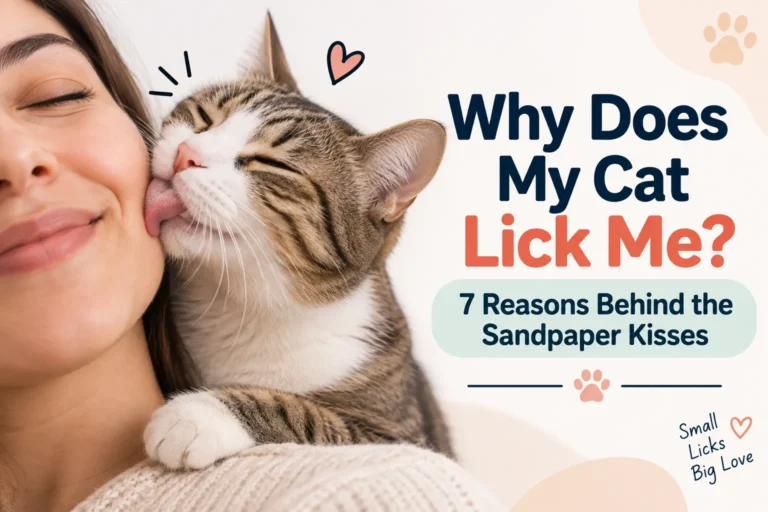
Quick answer: Cats lick their owners mainly to groom them, which is a family bonding behavior called allogrooming. Licking also spreads your cat’s scent, marking you as part of its group, and can express affection, seek attention, or self soothe stress. The rough sandpaper feel comes from backward facing spines on the tongue built for grooming fur.
A cat’s lick feels nothing like a dog’s. The tongue rasps like wet sandpaper, because it carries hundreds of tiny backward facing spines called papillae, made of the same keratin as claws. Those spines evolved to pull loose fur and dirt out of a coat, and to strip meat from bone.
So when that specialized grooming tool goes to work on your hand, your arm, or your hair, your cat is saying something specific. Here are the seven reasons, ranked by how often they explain the behavior.
7 reasons your cat licks you
1. You are being groomed as family
The top reason. Cats that live together groom each other, a behavior called allogrooming, and they only do it inside their trusted social circle. Mothers groom kittens, bonded cats groom each other, and your cat grooms you. Licking your hand or hair means your cat has filed you under family and is doing its share of your hygiene, by cat standards.
2. Marking you with scent
Grooming spreads scent, and scent is identity for cats. By licking you, your cat blends its smell with yours into a shared group scent, the same reason it rubs its cheeks on you. You are being labeled: mine, safe, family.
3. Affection
Licking releases calming endorphins in cats, and grooming you is a way of extending that comfort to you. Many cats lick during cuddle sessions alongside purring and the kneading we explained in why cats knead. The whole package is a cat expressing full contentment.
4. Attention seeking
A lick gets a reaction, especially a raspy lick on bare skin at 6 am. If your cat licks you and then stares, leads you somewhere, or meows, the lick is a polite tap on the shoulder. What you do next teaches your cat whether licking works, the same learning loop behind demand meowing.
5. Taste
Sweat leaves salt on your skin, and lotions, food residue, or even chlorine after a swim can make your arm genuinely interesting. If the licking happens mostly after workouts or cooking, your cat may simply be sampling you.
6. Self soothing
Licking calms cats, so some cats lick their owners when stressed, during storms, vet visits, or household changes. Licking you combines the soothing action with the comfort of your presence. Occasional stress licking is fine; constant frantic licking of you or itself signals anxiety worth addressing.
7. Kitten behavior that stuck
Cats weaned too early often develop stronger licking and suckling habits, sometimes licking skin or fabric in long sessions. Like intense kneading, it is a leftover nursing comfort behavior and is harmless unless it becomes obsessive.
Lick meanings at a glance
| The licking pattern | Most likely meaning |
|---|---|
| Calm licks during cuddles, with purring | Grooming and affection |
| Licking your hair or head | Full family grooming treatment |
| Lick, then stare or lead you somewhere | Attention or food request |
| Licking after your workout or cooking | Taste, salt, or food residue |
| Licking during storms or upheaval | Self soothing |
| Lick then gentle bite then lick | Grooming or play, see below |
| Frantic constant licking | Anxiety, worth attention |
If the licking comes packaged with gentle nips, that combination has its own full explanation in why cats bite then lick you. The short version: teeth plus tongue is exactly how cats groom each other, so you are still being treated as family.
🐱 Translate the whole message
Licks, purrs, tail flicks, chirps. Enter what your cat is doing and our free Cat Language Translator gives you the most likely meaning in seconds.
Try the Cat Language TranslatorWhy cat licks feel like sandpaper
A cat’s tongue carries around 300 hollow, backward curving spines. Each papilla wicks saliva deep into fur, which is how cats keep coats clean without water. The spines also explain why a cat that starts licking a blanket sometimes gets briefly stuck: the hooks catch loops of fabric.
The rasp on your skin is those spines doing exactly what they were built for. A few licks feel pleasant, but a long session on one patch of skin can turn raw, which is a fine reason to redirect gently.
How to stop licking you do not want
- Redirect, never punish. When the licking gets too much, calmly move your arm away and offer a toy, brushing session, or petting on your terms. Punishing a grooming behavior confuses a cat that thinks it is being kind to you.
- Do not reward the 6 am wake up licks. Stay still and boring. Reacting, even negatively, confirms that licking wakes the food source.
- Check your skin products. If your cat obsessively licks lotioned skin, switch products, since some lotions and ointments are toxic to cats. Never let a cat lick skin with medicated creams on it.
- Meet the need behind stress licking. More play, consistent routine, and safe hiding spots reduce anxiety driven licking better than any deterrent.