
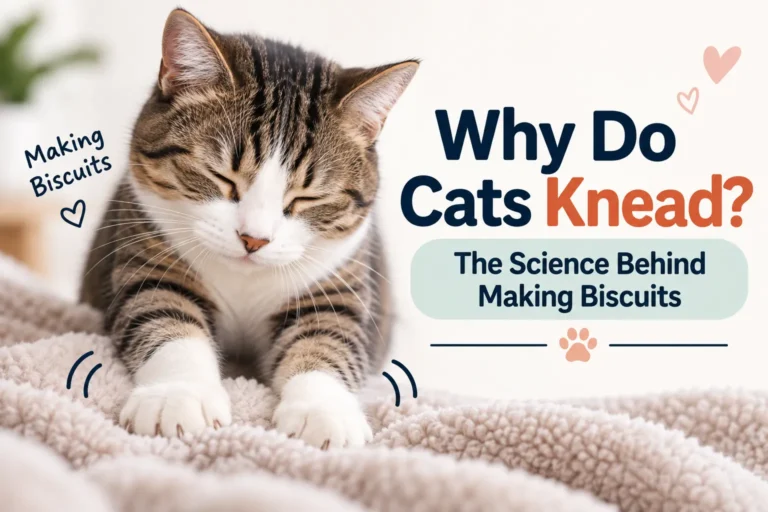
Quick answer: Cats knead because of an instinct from kittenhood. Kittens press their paws against their mother’s belly to stimulate milk flow, and the motion becomes wired to comfort and contentment for life. When your adult cat kneads a blanket or your lap, it feels safe, relaxed, and often treats you as a mother figure. Kneading is one of the strongest signs of a happy cat.
The rhythmic push, left paw, right paw, often with a purr and half closed eyes. Cat owners call it making biscuits, and it is one of the most beloved and most asked about behaviors in cats.
Every cat kneads for the same root reason, but the target, the timing, and the intensity add extra layers of meaning. Here is the full picture.
The main reason: a kitten instinct that never leaves
Newborn kittens knead their mother’s belly while nursing. The pressing motion stimulates milk flow, so from the first days of life, kneading links directly to food, warmth, safety, and mother. Neuroscience calls this a fixed action pattern: a hardwired motor sequence tied to a reward.
Most animals drop nursing behaviors at weaning. Domestic cats keep them, and researchers believe domestication is the reason. Living with humans keeps cats in a permanent state of semi kittenhood, because we feed them, protect them, and groom them the way a mother cat would. The kneading survives because the conditions that created it never end.
So when your adult cat kneads your lap, the honest translation is: you make me feel the way my mother did. It is among the highest compliments in cat language, on the level of the slow blink we covered in why cats stare at you.
What kneading means in each situation
Kneading on you
Deep trust and bonding. Your cat associates you with the comfort of nursing. Many cats knead before settling on a lap, and some drool slightly while doing it, another leftover nursing reflex. If the claws hurt, put a folded blanket between your cat and your legs rather than stopping the behavior.
Kneading blankets and soft surfaces
Self soothing and nest preparation. Wild cats trample grass to make a soft sleeping spot, so kneading a blanket before lying down mixes the comfort instinct with old bedmaking behavior. It usually ends with the cat curling up on the kneaded spot.
Kneading with purring and drooling
Peak contentment. The purr, the drool, and the kneading all come from the nursing memory together. A cat in this state is as relaxed as a cat gets. You can hear what the purr adds to the message in our guide to cat sounds and their meanings.
Kneading and biting the blanket
Some cats knead while sucking or gently chewing fabric. This is stronger nursing behavior, most common in cats weaned too early. It is harmless in moderation. If a cat actually eats fabric, that is called pica and needs a vet conversation, because swallowed fabric can block the gut.
Kneading before sleep
Routine self comfort, the cat equivalent of fluffing a pillow. Completely normal.
Intense kneading in unspayed females
Females in heat knead more, often while stretching and vocalizing loudly. Paired with the yowling we described in the sounds guide, it signals hormonal behavior that spaying resolves.
Why does kneading feel so intense with claws?
Kneading extends the claws naturally with each push. Your cat is not scratching you on purpose; the claw extension is part of the motor pattern. Three fixes that keep everyone comfortable:
- Keep a dedicated kneading blanket on your lap during cuddle time.
- Trim the claw tips every couple of weeks, which blunts the pinch without affecting your cat.
- Never punish kneading. In cat terms, you would be punishing a hug.
🐱 What is your cat telling you?
Kneading, purring, chirping, tail flicks. Enter what you observe and our free Cat Language Translator gives you the most likely meaning in seconds.
Try the Cat Language TranslatorDo all cats knead?
Most cats knead, but not all, and frequency varies hugely. Cats weaned very early often knead more intensely, sometimes with fabric sucking. Cats weaned naturally may knead less. Some cats knead daily, others a few times a year, and a few never do. All of these are normal. A cat that never kneads is not unbonded, it simply expresses comfort through other channels like the slow blink, the upright tail we described in cat tail language, or sleeping pressed against you.
When kneading changes matter
Kneading itself is never a problem, but changes around it can carry information:
- A cat that suddenly stops kneading along with reduced play, hiding, or appetite loss may be in pain or unwell, since comfort behaviors fade when a cat feels bad.
- Kneading that becomes frantic with fabric eating points to pica and needs a vet conversation.
- New intense kneading with loud yowling in an unspayed female is heat behavior.