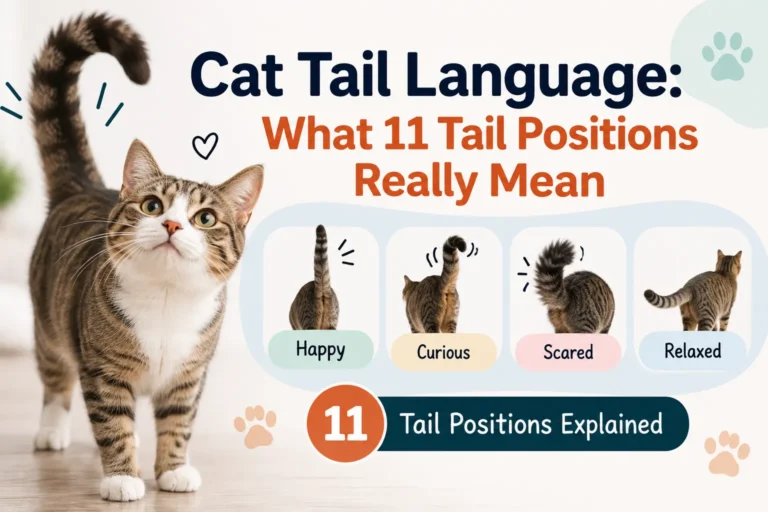
Quick answer: A cat’s tail is its clearest mood signal. Tail straight up means happy and confident, a question mark curve means playful and friendly, a puffed tail means fear, a low tucked tail means anxiety, and a twitching or thumping tail means irritation. Fast tail movement almost always means rising tension, while slow gentle movement means calm interest.
Dogs tell you their mood with the whole body. Cats put most of it in the tail. The tail acts like a mood antenna, broadcasting emotional state in real time, and cats cannot fake it. A cat may sit perfectly still while the twitching tail tip gives away that it is one stroke of petting from a nip.
Learn these 11 positions and you can read your cat’s state at a glance.
The 11 tail positions and their meanings
1. Tail straight up
The classic happy cat flag. An upright tail signals confidence, contentment, and friendly intent. Cats greet trusted humans and cats with the tail raised, often with a chirp or trill alongside it. This is your cat at its most comfortable.
2. Upright with a hooked tip (question mark)
An upright tail with a curved tip is an invitation. It means friendly curiosity and often a request to play or interact. Meet it with a greeting, a slow blink, or a short play session.
3. Tail wrapped around you or another cat
Cats wrap tails around companions the way humans put an arm around a friend. A tail curled around your leg or draped over another cat signals affection and social bonding.
4. Quivering upright tail
A tail held straight up and vibrating at the sight of you is excitement, the strongest greeting a cat gives. It often appears when you come home or right before meals. In unneutered cats, quivering with backing against surfaces can be spray marking, but a quiver aimed at you during greeting is pure enthusiasm.
5. Tail held loosely down, gentle sway
A relaxed tail in a natural low curve with a soft, slow sway means a calm, neutral cat going about its day. No message here beyond all is well.
6. Slow swishing side to side
Slow deliberate swishing means concentration, usually on prey or a toy. You will see it right before a pounce, often with the locked stare we covered in why cats stare at you. Let the pounce land on a toy, not your hand.
7. Twitching or flicking tail tip
The most useful signal on this list. A twitching tail tip means rising irritation. During petting, it is your early warning that your cat is approaching its tolerance limit, the overstimulation pattern we explained in why cats bite then lick. Stop petting at the first twitch and you avoid the nip entirely.
8. Thumping or lashing tail
A tail slapping the floor or whipping side to side is open annoyance or anger. The cat is telling you plainly to back off. Ignore it and the next signals are a growl, a hiss, or a swat.
9. Puffed up tail
A bottle brush tail means sudden fear or a startle. The fur stands on end to make the cat look bigger to a threat. Paired with an arched back and sideways stance, the cat is in full defensive display. Give space and remove the trigger. Never pick up a puffed cat.
10. Tail tucked low or under the body
A tail held low, clamped down, or tucked beneath the body signals anxiety, submission, or feeling unsafe. A cat that walks low with a tucked tail in a new environment is stressed. Chronic tail tucking at home means something in the environment worries your cat, like a new pet, loud noises, or a conflict with another cat.
11. Tail wrapped around its own body
A sitting or loafed cat with the tail neatly wrapped around its paws is settled and conserving warmth. It can also mean mild caution, a polite do not disturb. If the cat sits hunched with the tail tightly wrapped for long periods and moves little, it may be pain hiding, which deserves attention.
Cat tail language chart
| Tail position | Mood | What to do |
|---|---|---|
| Straight up | Happy, confident | Greet and interact |
| Up with hooked tip | Friendly, playful | Play or pet |
| Quivering upright | Excited to see you | Say hello |
| Wrapped around you | Affection | Enjoy it |
| Loose, gentle sway | Calm, neutral | Nothing needed |
| Slow swish | Hunting focus | Offer a toy |
| Twitching tip | Irritation building | Stop petting |
| Thumping or lashing | Angry | Back off now |
| Puffed up | Scared | Give space |
| Tucked low | Anxious | Remove stressor |
| Wrapped around paws | Settled or cautious | Let the cat rest |
🐱 Read the whole message, not just the tail
Combine tail position with sounds and ears in our free Cat Language Translator and get the most likely meaning in seconds.
Try the Cat Language TranslatorWhy tail wagging means the opposite of dogs
The single biggest mistake cat owners make is reading tail movement like dog tail wagging. In dogs, a fast wag usually means excitement and friendliness. In cats, the rule flips: the faster and harder the tail moves, the more agitated the cat. A still or slowly swaying tail is the content one.
This is why so many people get bitten “out of nowhere” while petting a wagging tailed cat. The cat was broadcasting irritation the whole time in a language the human read backwards. Pair the tail with the vocal signals from our guide to cat sounds and their meanings and the message is never ambiguous.
1 thought on “Cat Tail Language: What 11 Tail Positions Really Mean”